Vectors: lines and perpendicular feet
Practice section 1 of 6
Questions 1–6 in this collection
Practice questions
Worked example · 1 of 6
Build a line by extending and splitting a displacement
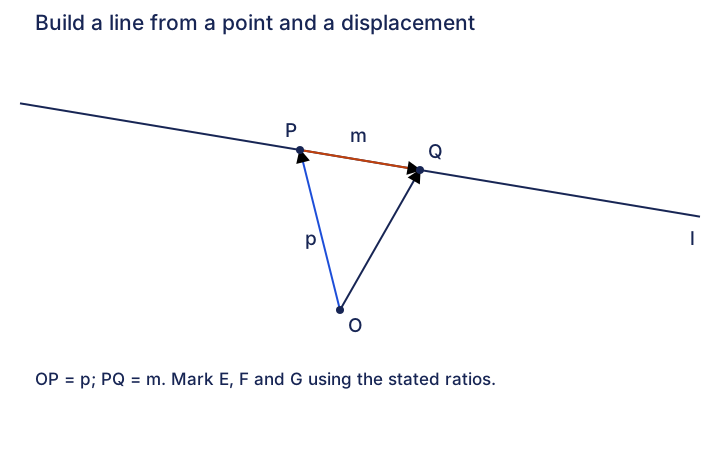
The line l passes through P and Q. The position vector of P is and .
(a) Express the position vector of Q in terms of p,m.
(b) E lies on PQ produced with PE=3 PQ; F is the midpoint of PQ; G lies on QP produced with PG:PQ=2:1. (i) Mark E,F,G on the diagram. (ii) Express their position vectors in terms of p,m.
(c) What can you conclude about the position vector of any point R on l?
Expand diagramFit diagram to page
Use the scrollbars or arrow keys to inspect details.
CJC · Lecture · Exploration Activity
Solution
Worked example · 2 of 6
Convert a line through two points without dividing by zero
Find a vector equation and a Cartesian equation of the line passing through and .
CJC · Lecture · Example 20
Solution
Worked example · 3 of 6
Read a common Cartesian parameter and rescale it consistently
A line has equation . Find a vector equation of the line.
CJC · Lecture · Example 21
Solution
Self-practice · 4 of 6
Practise five conversions between vector and Cartesian forms
Self-Practice 7:
(a) Convert , λ real, to Cartesian form.
(b) Convert , λ real, to Cartesian form.
(c) Convert to a vector equation.
(d) Convert , z=4, to a vector equation.
(e) Give vector and Cartesian equations for the line through A with position vector , parallel to .
CJC · Lecture · Self-Practice 7
Solution
Worked example · 5 of 6
Check a point using one consistent parameter
Determine whether lies on the line in Example 21: , , equivalently .
CJC · Lecture · Example 22
Solution
Worked example · 6 of 6
Find a perpendicular foot, shortest distance and reflected point
The point is and the line is , .
(i) Find the coordinates of the foot of the perpendicular from P to the line.
(ii) Deduce the shortest distance from P to the line.
(iii) Find the position vector of the image of P in the line.
CJC · Lecture · Example 23