Porisma

Worked solution

Find point-to-line distance with cross product and projection

The points A,B,P have position vectors i+2j+3k\mathbf i+2\mathbf j+3\mathbf k, 2i+4j+4k2\mathbf i+4\mathbf j+4\mathbf k and i+j−k\mathbf i+\mathbf j-\mathbf k, respectively. Find the perpendicular distance from P to the line through A and B.

CJC · Lecture · Example 24

Find the two displacements and a unit line direction

Let F be the perpendicular foot. AB→=(2,4,4)−(1,2,3)=(1,2,1)\overrightarrow{AB}=(2,4,4)-(1,2,3)=(1,2,1) and AP→=(1,1,−1)−(1,2,3)=(0,−1,−4)\overrightarrow{AP}=(1,1,-1)-(1,2,3)=(0,-1,-4). Since ∣AB→∣=6|\overrightarrow{AB}|=\sqrt6, a unit direction is (1,2,1)/6(1,2,1)/\sqrt6.

How did this part go?

Method 1: expand the cross product before taking its magnitude

PF=∣AP→×(1,2,1)6∣PF=\left|\overrightarrow{AP}\times\frac{(1,2,1)}{\sqrt6}\right|. The Teacher completion expands the cross product as

(0,−1,−4)×(1,2,1)=((−1)(1)−(−4)(2), −[(0)(1)−(−4)(1)], (0)(2)−(−1)(1))=(7,−4,1).\begin{aligned}&(0,-1,-4)\times(1,2,1)\\ & =\big((-1)(1)-(-4)(2),\ -[(0)(1)-(-4)(1)],\ (0)(2)-(-1)(1)\big)\\ & =(7,-4,1).\end{aligned}

Therefore PF=16∣(7,−4,1)∣=49+16+16=11PF=\frac1{\sqrt6}|(7,-4,1)|=\frac{\sqrt{49+16+1}}{\sqrt6}=\sqrt{11}.

How did this part go?

Method 2: find the projection length and use Pythagoras

The nonnegative projection length is AF=∣(0,−1,−4)⋅(1,2,1)/6∣=6/6=6AF=\left|(0,-1,-4)\cdot(1,2,1)/\sqrt6\right|=6/\sqrt6=\sqrt6. Also AP=02+(−1)2+(−4)2=17AP=\sqrt{0^2+(-1)^2+(-4)^2}=\sqrt{17}. Thus PF=AP2−AF2=17−6=11PF=\sqrt{AP^2-AF^2}=\sqrt{17-6}=\sqrt{11}. The signed projection is negative; its magnitude gives AF, but its sign puts F before A along AB. In fact F=(0,0,2), as in Example 23. This is distance to the infinite line: F need not lie on segment AB.

How did this part go?

Compare your sketch

Expand diagram

Use the scrollbars or arrow keys to inspect details.
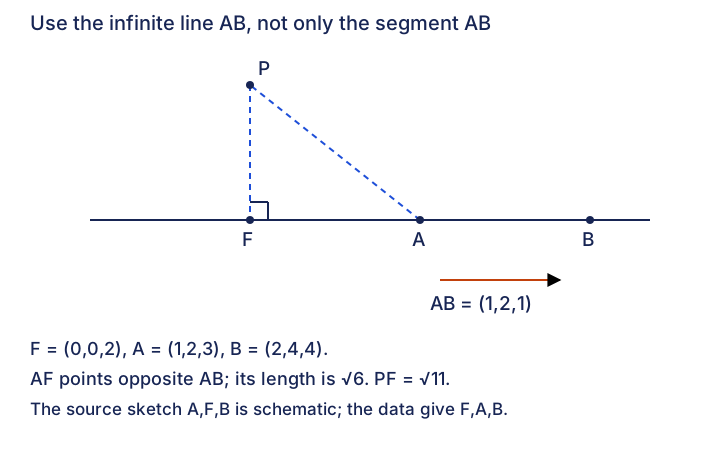
Corrected source schematic: F,A,B occur in that order on the infinite line, with A to F opposite AB. P lies off the line, PF is perpendicular, AP joins A to P, AF has length square root 6 and PF square root 11. The source Teacher drawing placed A,F,B, which is inconsistent with these coordinates.

Common mistakes

Normalise AB for either distance formula. The source Teacher sketch shows A,F,B, but these coordinates give F,A,B. Keep the absolute value for projection length and use the infinite line, not only segment AB.

Solution notes

The Teacher-only determinant expansion is integrated into Method 1. Its A,F,B schematic is corrected and explicitly qualified; the numerical answers in both copies agree.

Read the hint