Vectors: lines and perpendicular feet
Practice section 2 of 6
Questions 7–12 in this collection
Practice questions
Worked example · 1 of 6
Find point-to-line distance with cross product and projection
The points A,B,P have position vectors , and , respectively. Find the perpendicular distance from P to the line through A and B.
CJC · Lecture · Example 24
Solution
Worked example · 2 of 6
Classify eight pairs of lines in a cuboid
The diagram depicts a cuboid with vertices A,B,C,D,E,F,G,H. Write down whether each pair of lines is parallel, intersecting or skew: AC and CD; AE and DH; AE and CD; AF and BE; DG and BE; AD and GF; AH and CF; AH and BE.
Expand diagramFit diagram to page
Use the scrollbars or arrow keys to inspect details.
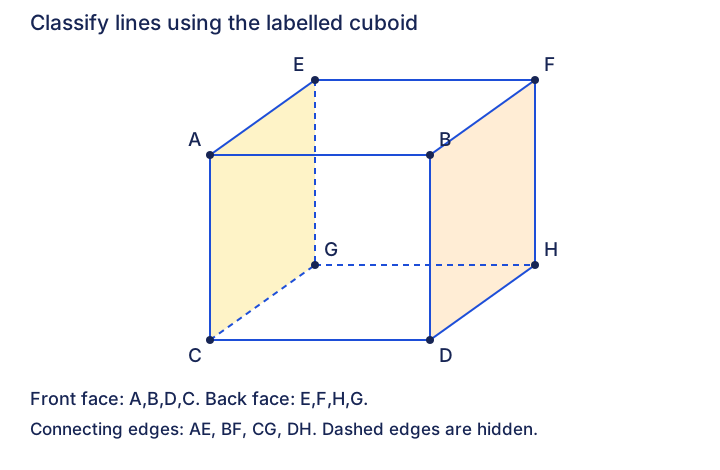
CJC · Lecture · Cuboid question (unnumbered)
Solution
Worked example · 3 of 6
Distinguish parallel, intersecting and skew lines algebraically
For each pair, test whether the lines are parallel, intersecting or skew. If they intersect, find the position vector of their intersection. All parameters are real.
(a) and .
(b) and .
(c) and .
CJC · Lecture · Example 25
Solution
Worked example · 4 of 6
Find the acute angle from line directions
Find the acute angle between and , with λ,μ real.
CJC · Lecture · Example 26
Solution
Self-practice · 5 of 6
Find a line intersection and its acute angle
Given and , with λ,μ real, find (i) their point of intersection and (ii) their acute angle.
CJC · Lecture · Self-Practice 8
Solution
Worked example · 6 of 6
Combine parallelogram vectors, an internal angle and a nearest point
With respect to origin O, A and C have position vectors and , respectively. B is such that OABC is a parallelogram.
(i) Write down the position vector of B.
(ii) Find angle OAB to the nearest degree.
(iii) Find a vector equation of line AB.
D has position vector .
(iv) Verify that D is on line AB.
(v) Find the position vector of the point on line AB closest to O.
CJC · Lecture · Example 27