Worked solution
Combine parallelogram vectors, an internal angle and a nearest point
With respect to origin O, A and C have position vectors and , respectively. B is such that OABC is a parallelogram.
(i) Write down the position vector of B.
(ii) Find angle OAB to the nearest degree.
(iii) Find a vector equation of line AB.
D has position vector .
(iv) Verify that D is on line AB.
(v) Find the position vector of the point on line AB closest to O.
CJC · Lecture · Example 27
(i) Use opposite sides and the triangle law
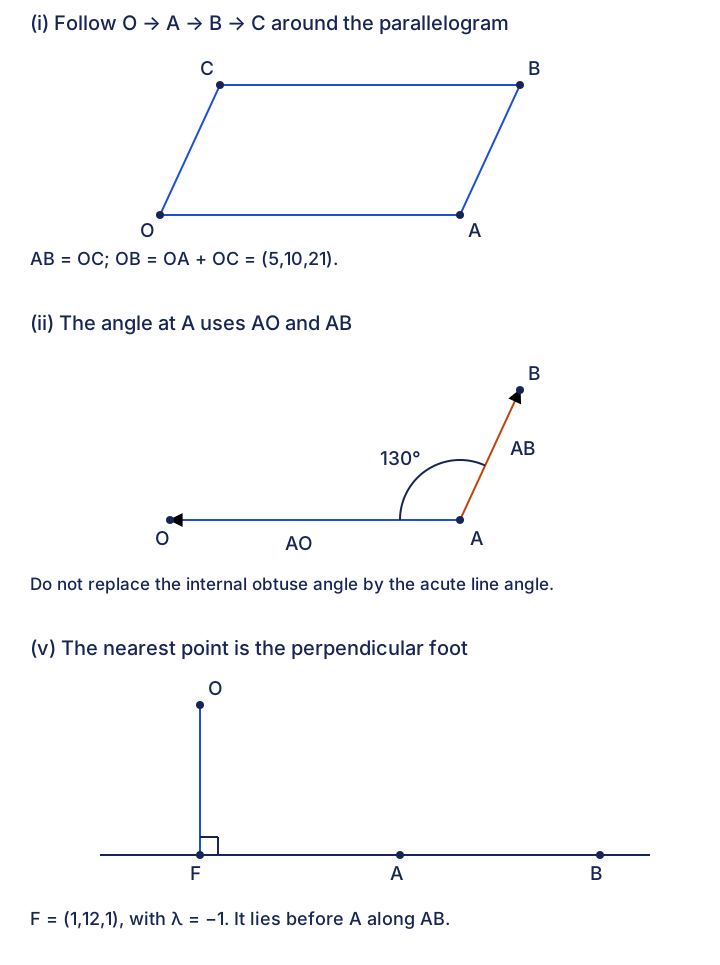
Follow the vertices O→A→B→C around the boundary, anticlockwise in the source schematic. Opposite sides OC and AB are equal and parallel in the same sense, so . By the triangle law, . The Teacher labelling note helps identify adjacent vertices; the cyclic order is what matters, since the apparent clockwise direction changes with the viewpoint.
(ii) Use vectors pointing away from the vertex A
and . Their dot product is and their magnitudes are and . Thus , giving to the nearest degree. This is the internal angle, so retain the negative dot product rather than forcing an acute answer.
(iii) Use A as a base point and AB as a direction
, .
(iv) Check D with one parameter
For D to lie on AB, . The three equations are , , . Each gives λ=−2. Therefore D lies on AB, as required.
(v) Require the position vector of the foot to be perpendicular to AB
Let F be the foot from O. Since F is on AB, . The nearest point satisfies . Expanding gives , or , so λ=−1. Therefore . Its dot product with AB is , confirming perpendicularity. The foot is before A on the infinite line, as in the source figure.
Compare your sketch
Expand diagramFit diagram to page
Use the scrollbars or arrow keys to inspect details.
Common mistakes
OABC lists successive boundary vertices: use AB=OC, not AB=−OC. Angle OAB is an internal angle at A, not necessarily the acute angle between the supporting lines. The nearest point can lie outside segment AB.
Solution notes
All five asks, source algebra and three geometric constructions retained. The Teacher-only anticlockwise naming note is integrated into the parallelogram step with a viewpoint qualification. The final dot-product confirmation is supplementary.