Worked solution
Classify eight pairs of lines in a cuboid
The diagram depicts a cuboid with vertices A,B,C,D,E,F,G,H. Write down whether each pair of lines is parallel, intersecting or skew: AC and CD; AE and DH; AE and CD; AF and BE; DG and BE; AD and GF; AH and CF; AH and BE.
Expand diagramFit diagram to page
Use the scrollbars or arrow keys to inspect details.
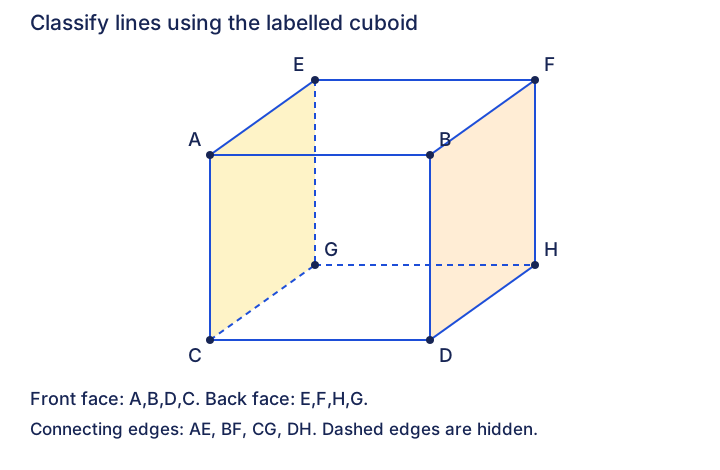
CJC · Lecture · Cuboid question (unnumbered)
AC and CD
Intersecting. They share the vertex C.
AE and DH
Parallel. They are corresponding front-to-back edges.
AE and CD
Skew. They are nonparallel, do not meet and lie in different planes.
AF and BE
Intersecting. They are the two diagonals of the top face ABEF and meet at its centre.
DG and BE
Parallel. They are matching diagonals in the parallel bottom and top faces.
AD and GF
Skew. These diagonals of opposite faces have different directions and cannot meet.
AH and CF
Intersecting. These space diagonals meet at the centre of the cuboid.
AH and BE
Skew. The space diagonal AH meets the top face only at A, which is not on BE; their directions differ.
Common mistakes
A crossing in a flat drawing does not prove that lines meet in space. Distinct lines are skew only when they are both nonparallel and nonintersecting.
Solution notes
This is the unnumbered printed cuboid question on page 61, not a numbered Example or a second numbered Exploration Activity. The source number 0 is an internal sentinel for an unnumbered activity. Teacher answers retained; explanatory reasons are supplementary.