Worked solution
Build a line by extending and splitting a displacement
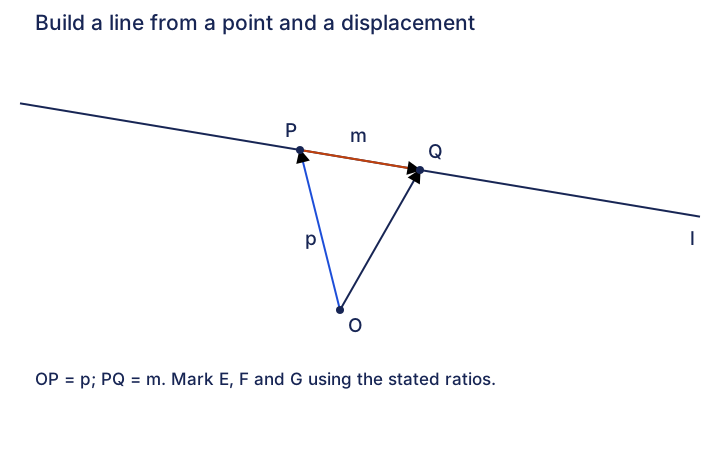
The line l passes through P and Q. The position vector of P is and .
(a) Express the position vector of Q in terms of p,m.
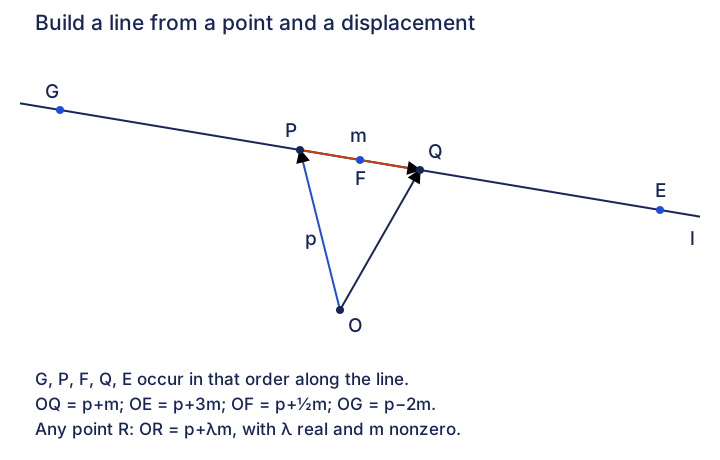
(b) E lies on PQ produced with PE=3 PQ; F is the midpoint of PQ; G lies on QP produced with PG:PQ=2:1. (i) Mark E,F,G on the diagram. (ii) Express their position vectors in terms of p,m.
(c) What can you conclude about the position vector of any point R on l?
Expand diagramFit diagram to page
Use the scrollbars or arrow keys to inspect details.
CJC · Lecture · Exploration Activity
(a) Add the displacement from P to Q
.
(b)(i) Mark the points in the correct order
E is beyond Q in the P→Q direction, F is halfway along PQ, and G is beyond P in the opposite direction. Their order along the line is G,P,F,Q,E. The completed figure marks all three positions.
(b)(ii) Use the signed multiples of m
, , and . The negative sign places G opposite the direction from P to Q.
(c) Let the scalar range over all real values
Every point R has for some . Here P,Q are distinct, so m≠0. Negative values extend behind P, values between 0 and 1 lie within PQ, and values above 1 extend beyond Q.
Compare your sketch
Expand diagramFit diagram to page
Use the scrollbars or arrow keys to inspect details.
Common mistakes
Use a negative displacement for G; a length ratio alone does not choose the direction.