Porisma

Worked solution

Cut a cuboid and check where a perpendicular drill exits

A computer-controlled machine makes plane cuts by using the equation of the cutting plane, and drills straight holes by using the equation of a drill line.

A 10 cm×20 cm×30 cm10\text{ cm}\times20\text{ cm}\times30\text{ cm} cuboid is positioned relative to the x-, y- and z-axes as in Figure 1. The diagram fixes the positive directions: OA=10OA=10 cm along positive y, AB=20AB=20 cm along negative x, and BF=30BF=30 cm along positive z.

First a plane cut removes the corner at E. It passes through P, Q and R, the midpoints of ED, EA and EF respectively.

(i) Show that PQ→=(0,5,−15)\overrightarrow{PQ}=(0,5,-15) and PR→=(−10,5,0)\overrightarrow{PR}=(-10,5,0).

(ii) Find the Cartesian equation of the plane p containing P, Q and R.

(iii) Find the acute angle between p and the plane DEFG.

A hole is then drilled perpendicular to triangle PQR, as in Figure 2. It passes through T, which divides PS in the ratio PT:TS=4:1PT:TS=4:1, where S is the midpoint of QR.

(iv) Show that T has coordinates (−4,9,24)(-4,9,24).

(v) State the vector equation of the drill line.

(vi) If drilling continues through the cuboid along that line, determine whether the drill exits from plane OABC or ODGC. Justify your answer.

Expand diagram

Use the scrollbars or arrow keys to inspect details.
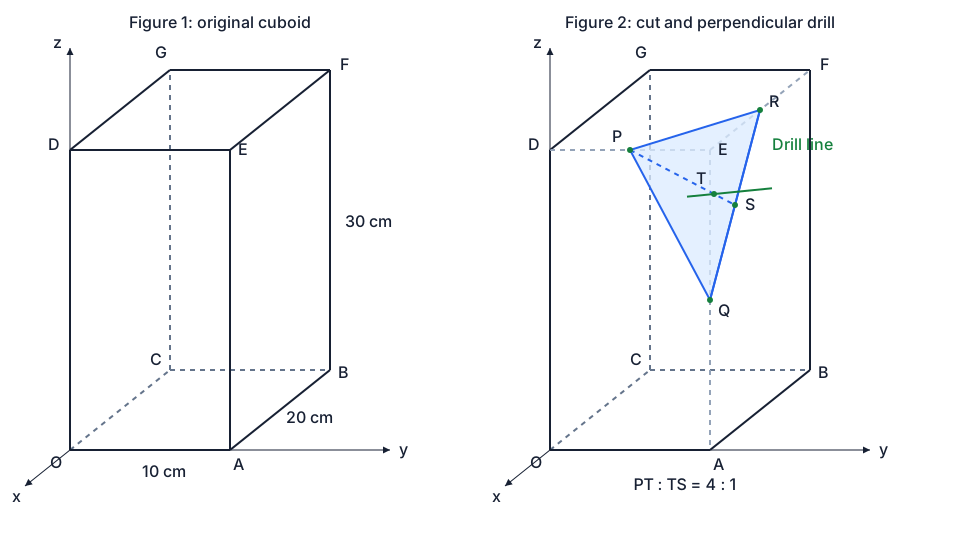
Figures 1 and 2: labelled cuboid OABC/DEFG, with OABC the bottom and DEFG the top. OA is 10 cm along positive y, AB is 20 cm along negative x, BF is 30 cm along positive z. P,Q,R are midpoints of ED, EA, EF. The cut removes E. S is midpoint of QR, T divides PS four to one, and a perpendicular drill passes through T. The exit is to be determined.

2017/SAJC/I/11

CJC · Lecture · Example 42

(i) Read the axes and subtract midpoint positions

Answer

PQ→=(0,5,−15)\overrightarrow{PQ}=(0,5,-15) and PR→=(−10,5,0)\overrightarrow{PR}=(-10,5,0).

From Figure 1, O=(0,0,0)O=(0,0,0), D=(0,0,30)D=(0,0,30), E=(0,10,30)E=(0,10,30), A=(0,10,0)A=(0,10,0) and F=(−20,10,30)F=(-20,10,30). Moving from A towards B decreases x. The Teacher completions give

OP→=(0,5,30),OQ→=(0,10,15),OR→=(−10,10,30).\begin{aligned}\overrightarrow{OP}&=(0,5,30),\\\overrightarrow{OQ}&=(0,10,15),\\\overrightarrow{OR}&=(-10,10,30).\end{aligned}

Subtract the base point P:

PQ→=(0,10,15)−(0,5,30)=(0,5,−15),PR→=(−10,10,30)−(0,5,30)=(−10,5,0).\begin{aligned}\overrightarrow{PQ}&=(0,10,15)-(0,5,30)\\&=(0,5,-15),\\\overrightarrow{PR}&=(-10,10,30)-(0,5,30)\\&=(-10,5,0).\end{aligned}

These are displacement vectors in centimetres, not the position vectors of Q and R.

How did this part go?

(ii) Use the two cut directions to find its normal

Answer

p: 3x+6y+2z=90p:\ 3x+6y+2z=90.

Scale the two directions from (i) by 1/51/5 before taking their cross product:

n=(0,1,−3)×(−2,1,0)=(3,6,2).\begin{aligned}&\mathbf n\\ & =(0,1,-3)\times(-2,1,0)\\ & =(3,6,2).\end{aligned}

The component calculation is nx=1(0)−(−3)(1)=3n_x=1(0)-(-3)(1)=3, ny=(−3)(−2)−0(0)=6n_y=(-3)(-2)-0(0)=6, nz=0(1)−1(−2)=2n_z=0(1)-1(-2)=2. Use Q to find the constant, as in the source:

r⋅(3,6,2)=(0,10,15)⋅(3,6,2)=90.\begin{aligned}\mathbf r\cdot(3,6,2)&=(0,10,15)\cdot(3,6,2)\\&=90.\end{aligned}

Hence 3x+6y+2z=903x+6y+2z=90. P and R also satisfy this equation, which checks that the plane contains the whole triangle.

How did this part go?

(iii) Compare the cut normal with the top-face normal

Answer

73.4∘73.4^\circ.

The plane DEFG is the horizontal top face z=30z=30, with normal (0,0,1)(0,0,1), completing the Teacher blank. For the acute plane angle,

cos⁡θ=∣(0,0,1)⋅(3,6,2)∣9+36+4=∣2∣49=27,θ=cos⁡−1(2/7)=73.4∘ (to 1 d.p.).\begin{aligned}\cos\theta&=\frac{|(0,0,1)\cdot(3,6,2)|}{\sqrt{9+36+4}}\\&=\frac{|2|}{\sqrt{49}}=\frac27,\\\theta&=\cos^{-1}(2/7)=73.4^\circ\ \text{(to 1 d.p.)}.\end{aligned}

Use cosine for the angle between two planes.

How did this part go?

(iv) Find S, then divide PS in the printed ratio

Answer

T=(−4,9,24)T=(-4,9,24).

First average the endpoint position vectors of QR:

OS→=12[(0,10,15)+(−10,10,30)]=(−5,10,45/2).\begin{aligned}\overrightarrow{OS}&=\tfrac12[(0,10,15)+(-10,10,30)]\\&=(-5,10,45/2).\end{aligned}

Since PT:TS=4:1PT:TS=4:1, T is four fifths of the way from P to S. The source section formula is

OT→=4OS→+OP→4+1=15(−20,45,120)=(−4,9,24).\begin{aligned}\overrightarrow{OT}&=\frac{4\overrightarrow{OS}+\overrightarrow{OP}}{4+1}\\&=\frac15(-20,45,120)\\&=(-4,9,24).\end{aligned}

The larger weight goes on S, since T lies closer to S. As a check, 3(−4)+6(9)+2(24)=903(-4)+6(9)+2(24)=90, so T lies in the cut plane.

How did this part go?

(v) Use the cut-plane normal as the drill direction

Answer

r=(−4,9,24)+λ(3,6,2)\mathbf r=(-4,9,24)+\lambda(3,6,2), λ∈R\lambda\in\mathbb R.

The drill passes through T and is perpendicular to triangle PQR, so its direction is the plane normal (3,6,2)(3,6,2) from (ii). This gives the printed vector equation. The line allows every real parameter; the physical drill travels from T into the remaining cuboid in the negative-λ\lambda direction.

How did this part go?

(vi) Test both intersections against the finite faces

Answer

The drill exits through ODGC at (−17/2,0,21)(-17/2,0,21); it does not exit through OABC.

A point on the drill line is (−4+3λ,9+6λ,24+2λ)(-4+3\lambda,9+6\lambda,24+2\lambda). The cuboid occupies

−20≤x≤0,0≤y≤10,0≤z≤30.-20\le x\le0,\quad0\le y\le10,\quad0\le z\le30.

Case 1: OABC. Its supporting plane is z=0z=0, or r⋅(0,0,1)=0\mathbf r\cdot(0,0,1)=0. Substitution gives

24+2λ=0,λ=−12,r=(−40,−63,0).\begin{aligned}24+2\lambda&=0,\\\lambda&=-12,\\\mathbf r&=(-40,-63,0).\end{aligned}

This point lies outside the finite bottom face because its x and y coordinates fail the cuboid bounds. Thus the drill does not exit through OABC, even though its infinite line intersects the infinite plane z=0z=0.

Case 2: ODGC. Its supporting plane is y=0y=0, or r⋅(0,1,0)=0\mathbf r\cdot(0,1,0)=0:

9+6λ=0,λ=−32,r=(−172,0,21).\begin{aligned}9+6\lambda&=0,\\\lambda&=-\frac32,\\\mathbf r&=(-\tfrac{17}{2},0,21).\end{aligned}

Here −20≤−17/2≤0-20\le-17/2\le0 and 0≤21≤300\le21\le30, so the point lies on the finite face ODGC. It is reached from T in the inward direction before λ=−12\lambda=-12. Along −3/2≤λ≤0-3/2\le\lambda\le0, all cuboid bounds hold; also 3x+6y+2z=90+49λ≤903x+6y+2z=90+49\lambda\le90, so the segment stays in the remaining solid after E is cut away. Hence ODGC is the exit face.

Source correction. In the first case the source calls an intermediate intersection “plane ODGC”, although the case heading, normal (0,0,1)(0,0,1) and equation are for OABC. The calculation above uses OABC consistently; the original wording remains in the native transcription.

How did this part go?

Compare your sketch

Expand diagram

Use the scrollbars or arrow keys to inspect details.
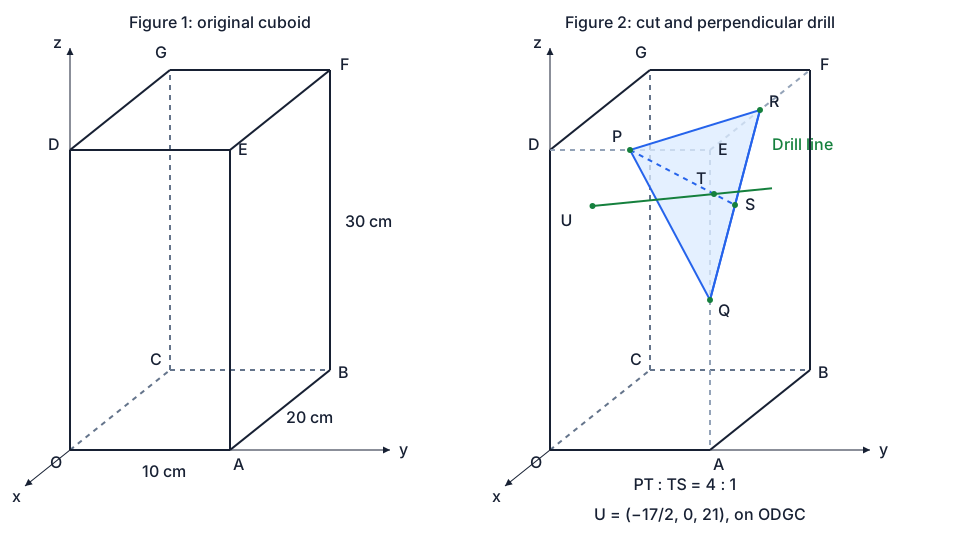
Two labelled perspective figures preserve the source cuboid. OABC is the bottom z=0 face, DEFG the top z=30 face, and ODGC the y=0 face. OA is 10 cm in positive y, AB is 20 cm in negative x, BF is 30 cm in positive z. P,Q,R bisect ED, EA, EF. Figure 2 marks the cut triangle, midpoint S of QR, T on PS with PT:TS=4:1, and the normal drill passing through T to exit ODGC. Perspective lengths are schematic.

Solution notes

All six numbered asks, both source figures and the 2017/SAJC/I/11 attribution are retained. Teacher-only position-vector and top-normal completions are integrated into (i) and (iii). Other displayed derivations are already printed in the Student copy.

Coordinates are in centimetres. Ordered triples represent the same vectors as the printed column-vector notation. The source face-label typo is qualified in (vi); the original native transcription is preserved.