Vectors: planes, normals and distances
Practice section 3 of 7
Questions 13–18 in this collection
Practice questions
Worked example · 1 of 6
Use two plane normals and their common base point
Find the line of intersection of
and
where all four parameters are real.
CJC · Lecture · Example 40
Solution
Worked example · 2 of 6
Measure the acute angle using two plane normals
Find the acute angle between the planes
CJC · Lecture · Example 41
Solution
Worked example · 3 of 6
Cut a cuboid and check where a perpendicular drill exits
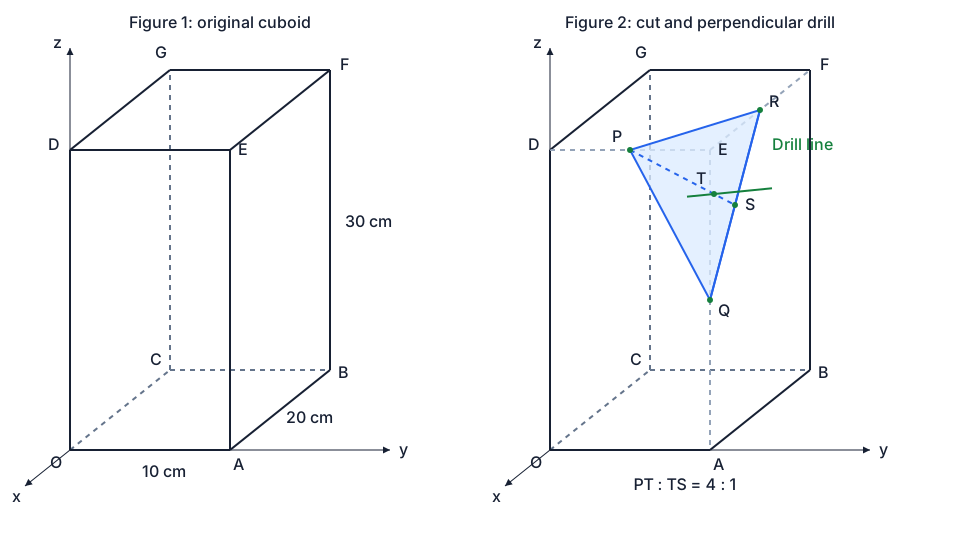
A computer-controlled machine makes plane cuts by using the equation of the cutting plane, and drills straight holes by using the equation of a drill line.
A cuboid is positioned relative to the x-, y- and z-axes as in Figure 1. The diagram fixes the positive directions: cm along positive y, cm along negative x, and cm along positive z.
First a plane cut removes the corner at E. It passes through P, Q and R, the midpoints of ED, EA and EF respectively.
(i) Show that and .
(ii) Find the Cartesian equation of the plane p containing P, Q and R.
(iii) Find the acute angle between p and the plane DEFG.
A hole is then drilled perpendicular to triangle PQR, as in Figure 2. It passes through T, which divides PS in the ratio , where S is the midpoint of QR.
(iv) Show that T has coordinates .
(v) State the vector equation of the drill line.
(vi) If drilling continues through the cuboid along that line, determine whether the drill exits from plane OABC or ODGC. Justify your answer.
Expand diagramFit diagram to page
Use the scrollbars or arrow keys to inspect details.
2017/SAJC/I/11
CJC · Lecture · Example 42
Solution
Discussion practice · 4 of 6
Three forms of a plane in four settings
Find the vector equations of the plane in parametric form and scalar product form, and also the Cartesian equation of the plane if
(a) passes through the three points , , .
(b) contains the two lines , , and , .
(c) contains the point and the line , .
(d) contains the point and parallel to the y-z plane.
CJC · Discussion · Question 1
Solution
Discussion practice · 5 of 6
Classify a line relative to a plane before solving
Determine whether each line intersects the plane at a unique point, lies on it, or does not intersect it. If there is a unique intersection, find that point and the angle between the line and plane. All parameters are real.
(a) , .
(b) , .
CJC · Discussion · Question 2
Solution
Discussion practice · 6 of 6
Use a plane normal to measure distance and construct a perpendicular plane
The line passes through and . The plane has equation .
(i) Show is parallel to, but not contained in, .
(ii) Find the distance of from .
(iii) Find a Cartesian equation of the plane containing and perpendicular to .
[2010/JJC/I/7]
CJC · Discussion · Question 3