Porisma

Worked solution

Recognise a right-endpoint sum and a cube-root limit

(i) For continuous ff, explain with a sketch why

lim⁡n→∞1n[f(1n)+f(2n)+⋯+f(nn)]=∫01f(x) dx.\lim_{n\to\infty}\frac1n\left[f\left(\frac1n\right)+f\left(\frac2n\right)+\cdots+f\left(\frac nn\right)\right]=\int_0^1f(x)\,dx.
marks

(ii) Hence evaluate lim⁡n→∞1n(13+23+⋯+n3n3)\displaystyle\lim_{n\to\infty}\frac1n\left(\frac{\sqrt[3]1+\sqrt[3]2+\cdots+\sqrt[3]n}{\sqrt[3]n}\right). marks

[N2015/I/3]

CJC · Review problems · Question 2

Answer

3/43/4.

(i) Identify width, sample point and height

Partition [0,1][0,1] into nn strips of width Δx=1/n\Delta x=1/n. In strip [(r−1)/n,r/n][(r-1)/n,r/n], the right-endpoint height is f(r/n)f(r/n) and the signed rectangle contribution is f(r/n)/nf(r/n)/n. Summing gives the displayed expression. Continuity on the closed interval ensures its Riemann sums converge to ∫01f(x) dx\int_0^1f(x)\,dx. For positive ff this is ordinary area; where f<0f<0 the contributions are signed, so continuity does not imply the integral is a nonnegative geometric area.

How did this part go?

(ii) Rewrite before identifying the function

Distribute the cube-root denominator: r3/n3=(r/n)1/3\sqrt[3]r/\sqrt[3]n=(r/n)^{1/3}. The limit is the right-endpoint sum for f(x)=x1/3f(x)=x^{1/3}, hence ∫01x1/3 dx=[34x4/3]01=3/4\int_0^1x^{1/3}\,dx=[\tfrac34x^{4/3}]_0^1=3/4. The source method is: rewrite to match (i), identify ff, then apply the integral result.

How did this part go?

Compare your sketch

Expand diagram

Use the scrollbars or arrow keys to inspect details.
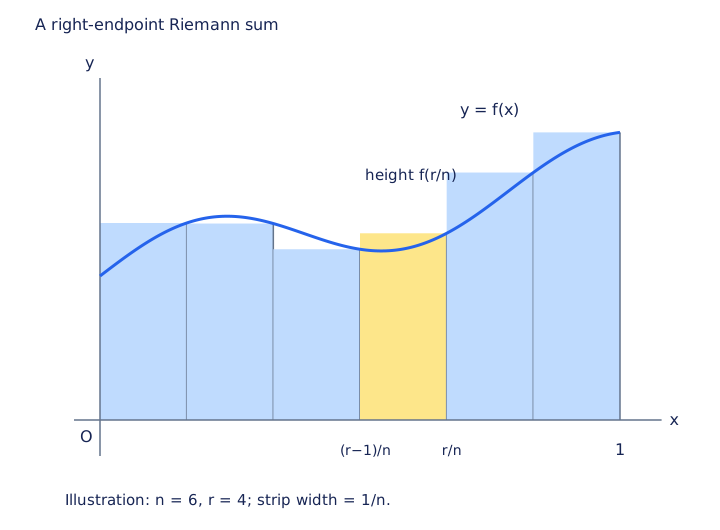
Illustrative right-endpoint rectangles on [0,1]. The r-th rectangle has width 1/n, horizontal interval [(r−1)/n,r/n], and height f(r/n); the limit is the integral for any continuous f.

Common mistakes

For a general continuous function, rectangle contributions represent signed integral values rather than unsigned area.

Read the hint