Review practice · Section 1 of 3
Questions 1–6 in this collection
Use horizontal rectangles and the complementary region · Recognise a right-endpoint sum and a cube-root limit · +4 more
- 1
The region is bounded by the x-axis, y-axis, and , . The diagram approximates its area by , the total area of rectangles of height , whose widths use the lower y-endpoint of each strip. Show that
Another finite region is bounded by the x-axis, and , . Explain how approximates the area of , and whether this underestimates or overestimates it, giving a reason. Find the exact volume when rotates completely about the y-axis.
Expand diagramFit diagram to page
Use the scrollbars or arrow keys to inspect details.
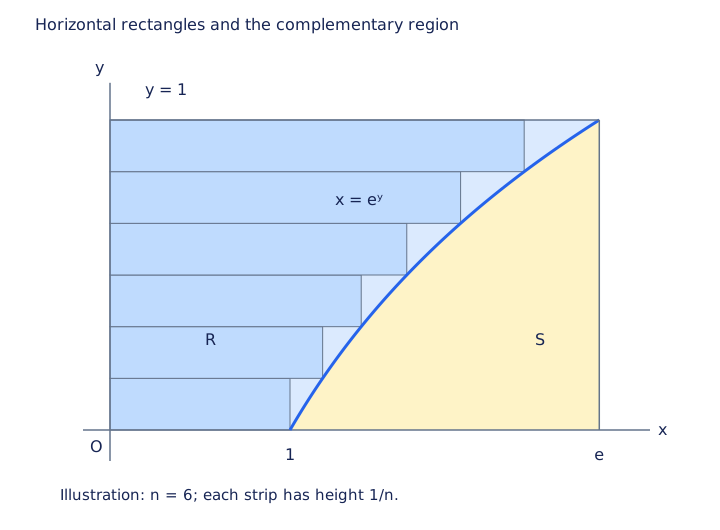
Horizontal rectangles lie inside R, to the left of x=exp(y), between y=0 and y=1. Each uses its lower y-endpoint width. S lies between that curve and x=e, inside the same enclosing rectangle. [2014/TJC/I/10]
CJC · Review problems · Question 1
- 2
(i) For continuous , explain with a sketch why
marks(ii) Hence evaluate . marks
[N2015/I/3]
CJC · Review problems · Question 2
- 3
Find .
CJC · Review problems · Question 3
- 4
Find , where is an even integer. Leave the answer in the form and determine . marks
[2018/IJC/I/2]
CJC · Review problems · Question 4
- 5
(a) The ellipse has .
(i) Show its enclosed area is . mark Use to find in terms of . marks
(ii) Rotate the enclosed region through radians about the x-axis to form an ellipsoid. Find its volume. marks
(b) The curved surface area generated by completely rotating a nonnegative curve , , about the x-axis is
Use the circle , , to show the surface area of a sphere is . marks
[2019/ACJC/II/3]
CJC · Review problems · Question 5
- 6
(a) Find the exact value of . marks
(b) Find . Hence find the exact constant satisfying
marks[2013/RI/I/12]
CJC · Review problems · Question 6