Porisma

Worked solution

Compare an arcsine integral with an absolute-value area

(a) Find the exact value of ∫12x2ln⁡x dx\int_1^2x^2\ln x\,dx. marks

(b) Find ∫9/3+2x−x2 dx\int9/\sqrt{3+2x-x^2}\,dx. Hence find the exact constant aa satisfying

∫0293+2x−x2 dx=∫−1/2aπ∣1−2x∣ dx.\int_0^2\frac9{\sqrt{3+2x-x^2}}\,dx=\int_{-1/2}^{a}\pi|1-2x|\,dx.
marks

[2013/RI/I/12]

CJC · Review problems · Question 6

Answer

(a) 8ln⁡2/3−7/98\ln2/3-7/9; (b) 9sin⁡−1((x−1)/2)+C9\sin^{-1}((x-1)/2)+C, a=(1+22)/2a=(1+2\sqrt2)/2.

(a) Integrate by parts

∫12x2ln⁡x dx=[x3ln⁡x/3−x3/9]12=8ln⁡2/3−7/9\int_1^2x^2\ln x\,dx=[x^3\ln x/3-x^3/9]_1^2=8\ln2/3-7/9.

How did this part go?

(b) Complete the square and evaluate the left side

3+2x−x2=4−(x−1)23+2x-x^2=4-(x-1)^2, so the antiderivative is 9sin⁡−1((x−1)/2)+C9\sin^{-1}((x-1)/2)+C on −1<x<3-1<x<3. The left side is 9[sin⁡−1(1/2)−sin⁡−1(−1/2)]=3π9[\sin^{-1}(1/2)-\sin^{-1}(-1/2)]=3\pi.

How did this part go?

(b) Establish which side of the corner contains a

From −1/2-1/2 to 1/21/2, the graph of ∣1−2x∣|1-2x| is a triangle of base 11 and height 22, so its integral is 11. The cumulative integral from −1/2-1/2 is increasing; to reach 33 it must continue past 1/21/2. Thus a>1/2a>1/2, before removing the absolute value on the remaining interval.

How did this part go?

(b) Solve and reject the incompatible root

1+∫1/2a(2x−1) dx=31+\int_{1/2}^a(2x-1)\,dx=3 gives 1+[x2−x]1/2a=31+[x^2-x]_{1/2}^a=3, hence a2−a−7/4=0a^2-a-7/4=0. Thus a=(1±22)/2a=(1\pm2\sqrt2)/2; only a=(1+22)/2a=(1+2\sqrt2)/2 satisfies a>1/2a>1/2.

How did this part go?

Compare your sketch

Expand diagram

Use the scrollbars or arrow keys to inspect details.
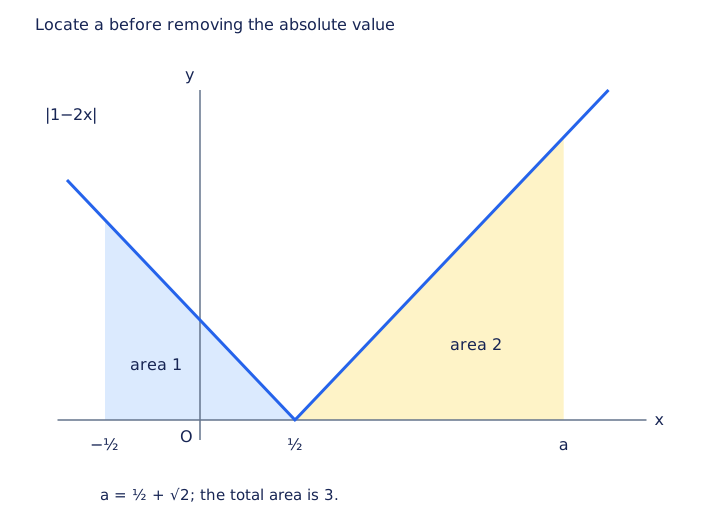
The V-shaped graph y=|1−2x| has corner (1/2,0). The triangle from x=−1/2 to 1/2 has area 1; a lies to the right of 1/2 because total area must be 3.

Common mistakes

Solving a polynomial after removing an absolute value can introduce a root incompatible with the interval used.

Read the hint