Porisma

Worked solution

Combine inverse-sine integration with two rotation radii

(a) Find ∫sin⁡−1(3x) dx\int\sin^{-1}(3x)\,dx. marks

(b) The curves C1,C2C_1,C_2 are y=1−(3/π)x2y=1-(\sqrt3/\pi)x^2 and y=13cos⁡xy=\tfrac13\cos x. Rotate the first-quadrant region bounded by them and the y-axis through 360∘360^\circ about the y-axis. Find the volume to 2 decimal places. marks

[2018/HCI/Promo/3]

CJC · Review problems · Question 8

Answer

(a) xsin⁡−1(3x)+131−9x2+Cx\sin^{-1}(3x)+\tfrac13\sqrt{1-9x^2}+C; (b) 1.751.75 cubic units.

(a) Integrate the inverse sine by parts

∫sin⁡−1(3x) dx=xsin⁡−1(3x)−∫3x/1−9x2 dx=xsin⁡−1(3x)+131−9x2+C\int\sin^{-1}(3x)\,dx=x\sin^{-1}(3x)-\int3x/\sqrt{1-9x^2}\,dx=x\sin^{-1}(3x)+\tfrac13\sqrt{1-9x^2}+C. This real formula applies on the inverse-sine domain, with its derivative interpreted in the interior.

How did this part go?

(b) Locate the intersection before choosing radii

Solving 1−(3/π)x2=13cos⁡x1-(\sqrt3/\pi)x^2=\tfrac13\cos x in the first quadrant gives (α,β)≈(1.2810352,0.09524112)(\alpha,\beta)\approx(1.2810352,0.09524112). At height y∈[β,1]y\in[\beta,1], the outer radius satisfies x2=(π/3)(1−y)x^2=(\pi/\sqrt3)(1-y). For β≤y≤1/3\beta\le y\le1/3 there is an inner hole of radius cos⁡−1(3y)\cos^{-1}(3y); above 1/31/3 there is no hole.

How did this part go?

(b) Subtract the inner solid over only its height range

The source washer setup is

V=π∫β1π3(1−y) dy−π∫β1/3[cos⁡−1(3y)]2 dy≈1.75.\begin{aligned}&V\\ & =\pi\int_\beta^1\frac\pi{\sqrt3}(1-y)\,dy\\ &{}-\pi\int_\beta^{1/3}[\cos^{-1}(3y)]^2\,dy\approx1.75.\end{aligned}

Units are cubic. As an independent check, cylindrical shells give V=2π∫0αx[1−(3/π)x2−13cos⁡x] dxV=2\pi\int_0^\alpha x[1-(\sqrt3/\pi)x^2-\tfrac13\cos x]\,dx, with the same value.

How did this part go?

Compare your sketch

Expand diagram

Use the scrollbars or arrow keys to inspect details.
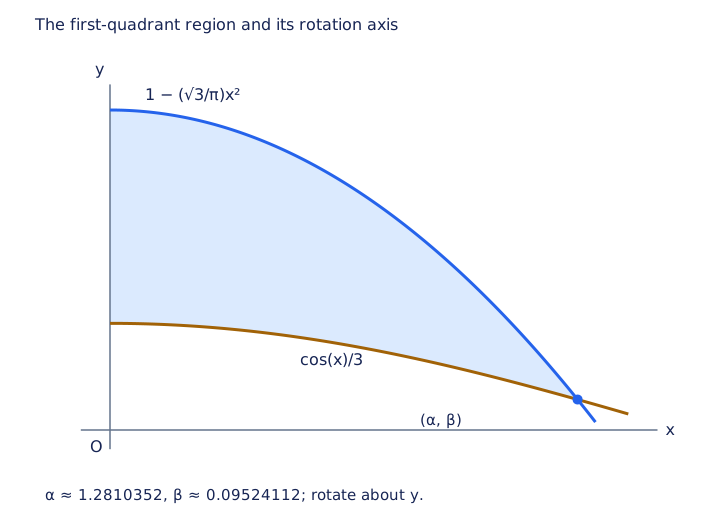
First-quadrant region between y=1−(sqrt(3)/pi)x² and y=cos(x)/3 from the y-axis to intersection (1.2810352,0.09524112). At heights below 1/3 a rotation washer has a hole; above 1/3 it is a disk.

Common mistakes

The parabola coefficient is sqrt(3)/pi, and the inverse-cosine radius must be squared in the washer integral.

Read the hint