Review practice · Section 2 of 3
Questions 7–12 in this collection
Reverse reciprocal-substitution bounds and reuse an integral · Combine inverse-sine integration with two rotation radii · +4 more
- 7
(a)(i) For , use to show . marks
(ii) Hence show , finding . marks
(b)(i) Show . marks
(ii) Without using a calculator, evaluate . marks
[2013/JJC/I/12]
CJC · Review problems · Question 7
- 8
(a) Find . marks
(b) The curves are and . Rotate the first-quadrant region bounded by them and the y-axis through about the y-axis. Find the volume to 2 decimal places. marks
[2018/HCI/Promo/3]
CJC · Review problems · Question 8
- 9
The diagram shows for .
(i) Find the area of , bounded by the curve, , and the y-axis.
(ii) Find the volume when rotates through about the x-axis.
(iii) Without using a calculator, find the exact area of , bounded by the curve, , and the x-axis.
Expand diagramFit diagram to page
Use the scrollbars or arrow keys to inspect details.
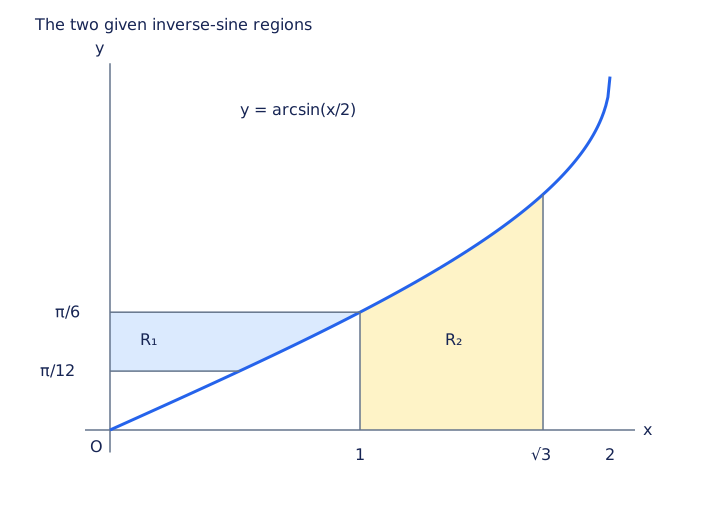
Given curve y=arcsin(x/2), 0≤x≤2. R1 is to the left of the curve between y=pi/12 and pi/6. R2 lies below the curve between x=1 and sqrt(3). Both named regions and boundary lines are shown. [2015/DHS/I/9]
CJC · Review problems · Question 9
- 10
The curve is , .
(i) Find its exact x-axis intercepts. marks
(ii) Sketch , stating all x- and y-axis intercept coordinates. marks
(iii) Find the exact value of . marks
(iv) Find the volume when the region bounded by , the x-axis and rotates completely about the x-axis. marks
[2014/IJC/I/11]
CJC · Review problems · Question 10
- 11
Sketch , . mark Rotate the region bounded by this curve, and both axes completely about the x-axis. Use to show the volume is , and evaluate it exactly. marks
[2014/YJC/II/3(c)]
CJC · Review problems · Question 11
- 12
The diagram shows and .
(i) State their intersection coordinates.
(ii) Find the exact area of the finite region between the two graphs.
(iii) The shaded region is bounded by the y-axis, the line and the lower part of the parabola. Find the volume when rotates through about the y-axis, to 2 decimal places.
Expand diagramFit diagram to page
Use the scrollbars or arrow keys to inspect details.
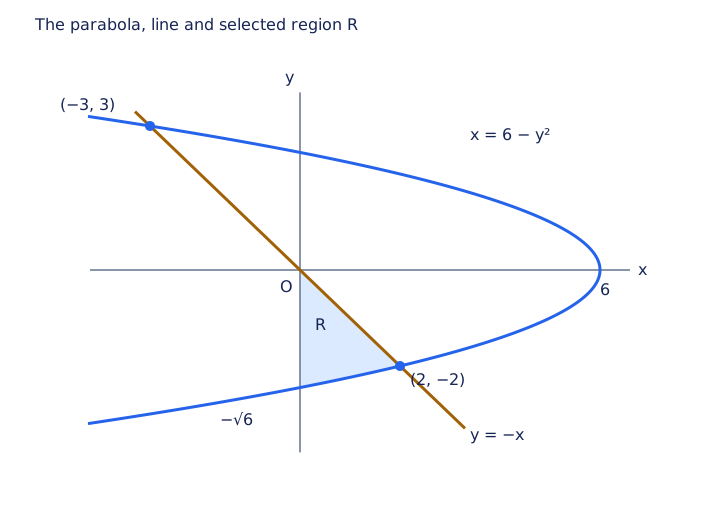
Parabola x=6 −y² and line x=−y intersect at (−3,3) and (2,−2). R is shaded between the y-axis and the nearer positive-x boundary, from y=−sqrt(6) to zero; it changes boundary at (2,−2). [2008/RJC/Promo/9(modified)]
CJC · Review problems · Question 12