Porisma

Worked solution

Use horizontal strips for an inverse-sine region

The diagram shows y=sin⁡−1(x/2)y=\sin^{-1}(x/2) for 0≤x≤20\le x\le2.

(i) Find the area of R1R_1, bounded by the curve, y=π/12y=\pi/12, y=π/6y=\pi/6 and the y-axis.

(ii) Find the volume when R1R_1 rotates through 2π2\pi about the x-axis.

(iii) Without using a calculator, find the exact area of R2R_2, bounded by the curve, x=1x=1, x=3x=\sqrt3 and the x-axis.

Expand diagram

Use the scrollbars or arrow keys to inspect details.
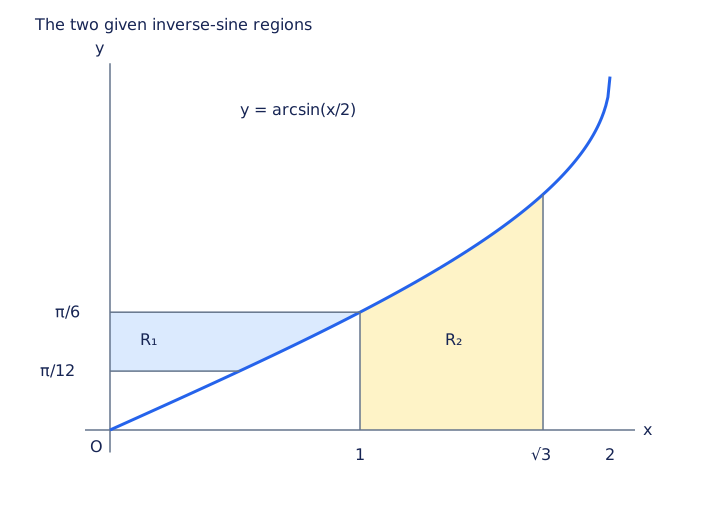
Given curve y=arcsin(x/2), 0≤x≤2. R1 is to the left of the curve between y=pi/12 and pi/6. R2 lies below the curve between x=1 and sqrt(3). Both named regions and boundary lines are shown.

[2015/DHS/I/9]

CJC · Review problems · Question 9

Answer

A1=0.200A_1=0.200 square units; V1=0.510V_1=0.510 cubic units (3 s.f.); A2=π6(23−1)+1−3A_2=\tfrac\pi6(2\sqrt3-1)+1-\sqrt3.

(i) Method 1: integrate horizontal widths

x=2sin⁡yx=2\sin y, so A1=∫π/12π/62sin⁡y dy=2[cos⁡(π/12)−cos⁡(π/6)]≈0.19980=0.200A_1=\int_{\pi/12}^{\pi/6}2\sin y\,dy=2[\cos(\pi/12)-\cos(\pi/6)]\approx0.19980=0.200 square units (3 s.f.).

How did this part go?

(i) Method 2: subtract the area below the curve

Let c=2sin⁡(π/12)c=2\sin(\pi/12). The same area is π/6−(π/12)c−∫c1sin⁡−1(x/2) dx\pi/6-(\pi/12)c-\int_c^1\sin^{-1}(x/2)\,dx, giving 0.2000.200 square units. The first term is the enclosing rectangle of width 11 and height π/6\pi/6.

How did this part go?

(ii) Use the source washer subtraction

For 0≤x≤c0\le x\le c, the radii are π/6\pi/6 and π/12\pi/12; for c≤x≤1c\le x\le1, the inner radius is sin⁡−1(x/2)\sin^{-1}(x/2). Equivalently V=π(π/6)2−π(π/12)2c−π∫c1[sin⁡−1(x/2)]2dx≈0.510V=\pi(\pi/6)^2-\pi(\pi/12)^2c-\pi\int_c^1[\sin^{-1}(x/2)]^2dx\approx0.510 cubic units (3 s.f.). Horizontal shells verify V=4π∫π/12π/6ysin⁡y dyV=4\pi\int_{\pi/12}^{\pi/6}y\sin y\,dy.

How did this part go?

(iii) Method 1: subtract the horizontal complement

The upper-right and lower-left rectangle terms give A2=3(π/3)−π/6−∫π/6π/32sin⁡y dy=π6(23−1)+1−3A_2=\sqrt3(\pi/3)-\pi/6-\int_{\pi/6}^{\pi/3}2\sin y\,dy=\tfrac\pi6(2\sqrt3-1)+1-\sqrt3.

How did this part go?

(iii) Method 2: integrate by parts directly

∫sin⁡−1(x/2) dx=xsin⁡−1(x/2)+4−x2+C\int\sin^{-1}(x/2)\,dx=x\sin^{-1}(x/2)+\sqrt{4-x^2}+C. Evaluating from 11 to 3\sqrt3 gives 3(π/3)+1−π/6−3=π6(23−1)+1−3\sqrt3(\pi/3)+1-\pi/6-\sqrt3=\tfrac\pi6(2\sqrt3-1)+1-\sqrt3, as above.

How did this part go?

Common mistakes

The two shaded regions use different strip directions and bounds; do not transfer the R2 x-bounds into R1.

Read the hint