Porisma

A hint to get started

Use horizontal strips for an inverse-sine region

The diagram shows y=sin⁡−1(x/2)y=\sin^{-1}(x/2) for 0≤x≤20\le x\le2.

(i) Find the area of R1R_1, bounded by the curve, y=π/12y=\pi/12, y=π/6y=\pi/6 and the y-axis.

(ii) Find the volume when R1R_1 rotates through 2π2\pi about the x-axis.

(iii) Without using a calculator, find the exact area of R2R_2, bounded by the curve, x=1x=1, x=3x=\sqrt3 and the x-axis.

Expand diagram

Use the scrollbars or arrow keys to inspect details.
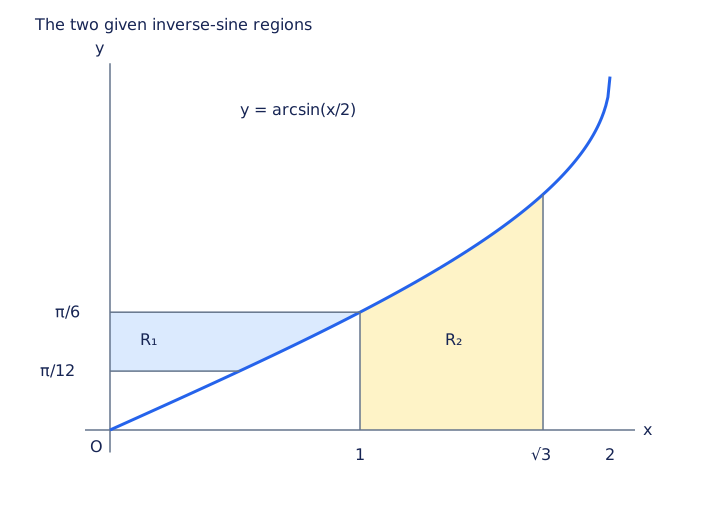
Given curve y=arcsin(x/2), 0≤x≤2. R1 is to the left of the curve between y=pi/12 and pi/6. R2 lies below the curve between x=1 and sqrt(3). Both named regions and boundary lines are shown.

[2015/DHS/I/9]

CJC · Review problems · Question 9

Invert the curve to x=2 sin y when the region is bounded by horizontal lines.

Read the worked solution