Worked solution
Distinguish a logarithm from its absolute-value graph
(i) Find .
(ii) Sketch , stating asymptotes and axis intercepts.
(iii) Find the exact area bounded by , the x-axis, and .
(iv) Find the volume when the region bounded by , the x-axis, and rotates completely about the y-axis.
[2015/HCI/II/4]
CJC · Review problems · Question 13
Answer
Antiderivative ; area ; volume cubic units.
(i) Integrate by parts and divide the rational term
, for .
(ii) Reflect only the negative logarithm branch
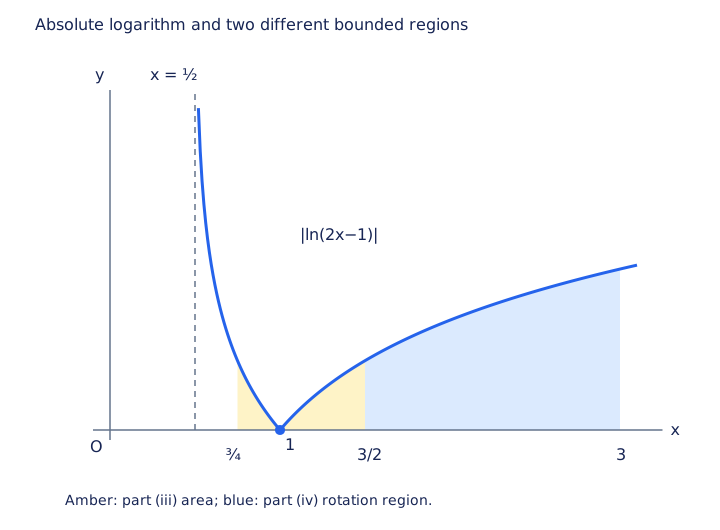
The absolute-value graph has domain and vertical asymptote . It decreases to the corner , then increases; there is no y-intercept. For it is ; for it is . The rendered source has modulus bars in (ii) and (iii), which extraction omits; (iv) uses the ordinary positive logarithm on its stated interval.
(iii) Split at the logarithm zero
Writing , the area is square units.
(iv) Use the enclosing cylinder subtraction
At height , the curve has . The source setup is . Equivalently shells give . Evaluation gives cubic units (3 s.f.).
Compare your sketch
Expand diagramFit diagram to page
Use the scrollbars or arrow keys to inspect details.
Common mistakes
Omitting the modulus changes the sketch and the requested geometric area.