Definite integrals, areas and volumes
Practice section 8 of 9
Questions 43–48 in this collection
Practice questions
Review practice · 1 of 6
Split an absolute integral at the sign change
The curve is , .
(i) Find its exact x-axis intercepts. [3]
(ii) Sketch , stating all x- and y-axis intercept coordinates. [2]
(iii) Find the exact value of . [4]
(iv) Find the volume when the region bounded by , the x-axis and rotates completely about the x-axis. [2]
[2014/IJC/I/11]
CJC · Review problems · Question 10
Solution
Review practice · 2 of 6
Transform a square-root exponential volume
Sketch , . [1] Rotate the region bounded by this curve, and both axes completely about the x-axis. Use to show the volume is , and evaluate it exactly. [6]
[2014/YJC/II/3(c)]
CJC · Review problems · Question 11
Solution
Review practice · 3 of 6
Read a selected region before splitting rotation disks
The diagram shows and .
(i) State their intersection coordinates.
(ii) Find the exact area of the finite region between the two graphs.
(iii) The shaded region is bounded by the y-axis, the line and the lower part of the parabola. Find the volume when rotates through about the y-axis, to 2 decimal places.
Expand diagramFit diagram to page
Use the scrollbars or arrow keys to inspect details.
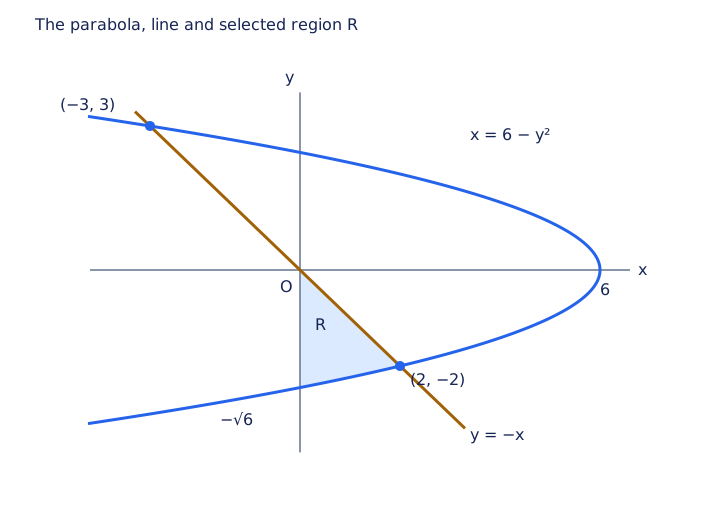
[2008/RJC/Promo/9(modified)]
CJC · Review problems · Question 12
Solution
Review practice · 4 of 6
Distinguish a logarithm from its absolute-value graph
(i) Find .
(ii) Sketch , stating asymptotes and axis intercepts.
(iii) Find the exact area bounded by , the x-axis, and .
(iv) Find the volume when the region bounded by , the x-axis, and rotates completely about the y-axis.
[2015/HCI/II/4]
CJC · Review problems · Question 13
Solution
Review practice · 5 of 6
Repeat a logarithmic segment with the correct jump values
Let for , and for , with for all real .
(a) Rotate the region bounded by , the x-axis and through about the x-axis. Find the exact volume.
(b) Sketch for . Hence find .
[2014/ACJC/I/10(ii)]
CJC · Review problems · Question 14
Solution
Review practice · 6 of 6
Use inverse symmetry to integrate only half the lens
Define for real .
(i) Sketch and show exists.
(ii) Find and its domain.
The intersections of and have x-coordinates and , where . Find the enclosed area in terms of .
[2013/AJC/II/1]
CJC · Review problems · Question 15