Porisma

Worked solution

Repeat a logarithmic segment with the correct jump values

Let f(x)=ln⁡xf(x)=\ln x for 1≤x≤e1\le x\le e, and f(x)=0f(x)=0 for e<x≤3e<x\le3, with f(x+2)=f(x)f(x+2)=f(x) for all real xx.

(a) Rotate the region bounded by y=f(x)y=f(x), the x-axis and x=ex=e through 2π2\pi about the x-axis. Find the exact volume.

(b) Sketch y=f(x)y=f(x) for −3≤x≤4-3\le x\le4. Hence find ∫−34f(x)dx\int_{-3}^4f(x)dx.

[2014/ACJC/I/10(ii)]

CJC · Review problems · Question 14

Answer

V=π(e−2)V=\pi(e-2); ∫−34f(x)dx=2+2ln⁡2≈3.39\int_{-3}^4f(x)dx=2+2\ln2\approx3.39.

(a) Integrate the squared logarithm twice by parts

On the intended base-period region 1≤x≤e1\le x\le e, V=π∫1e(ln⁡x)2dxV=\pi\int_1^e(\ln x)^2dx. Two integrations by parts give ∫(ln⁡x)2dx=x(ln⁡x)2−2xln⁡x+2x+C\int(\ln x)^2dx=x(\ln x)^2-2x\ln x+2x+C. Hence V=π(e−2)V=\pi(e-2). A source intermediate line drops the factor xx from −2xln⁡x-2x\ln x, but its following evaluation and final answer use the correct antiderivative.

How did this part go?

(b) Translate by multiples of two

On [1+2k,e+2k][1+2k,e+2k], f(x)=ln⁡(x−2k)f(x)=\ln(x-2k); on (e+2k,3+2k](e+2k,3+2k], f(x)=0f(x)=0. For the requested graph take k=−2,−1,0k=-2,-1,0 for three complete periods and k=1k=1 for the remaining segment 3≤x≤43\le x\le4. Each logarithmic top point (e+2k,1)(e+2k,1) is included, while the zero point immediately below it is open; the log starts (1+2k,0)(1+2k,0) are included. The last endpoint is (4,ln⁡2)(4,\ln2).

How did this part go?

(b) Method 1: use three full periods and a base partial period

∫−34f(x)dx=3∫1eln⁡x dx+∫12ln⁡x dx=3+(2ln⁡2−1)=2+2ln⁡2≈3.39\int_{-3}^4f(x)dx=3\int_1^e\ln x\,dx+\int_1^2\ln x\,dx=3+(2\ln2-1)=2+2\ln2\approx3.39 (3 s.f.).

How did this part go?

(b) Method 2: integrate the translated final segment

The last segment is f(x)=ln⁡(x−2)f(x)=\ln(x-2) on 3≤x≤43\le x\le4. Thus 3∫1eln⁡x dx+∫34ln⁡(x−2)dx3\int_1^e\ln x\,dx+\int_3^4\ln(x-2)dx gives the same 2+2ln⁡22+2\ln2.

How did this part go?

Compare your sketch

Expand diagram

Use the scrollbars or arrow keys to inspect details.
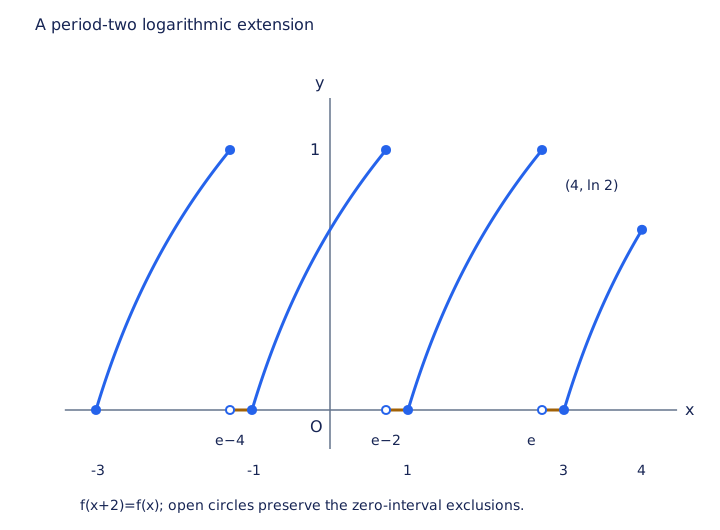
Period-two graph on [−3,4]: three full logarithmic rises from x=−3,−1,1 to included height-one points at e−4,e−2,e, followed by zero intervals with open left endpoints. A final rise runs from (3,0) to (4,ln2).

Common mistakes

A periodic extension repeats both the logarithmic segment and the following zero interval.

Read the hint