Worked solution
Use inverse symmetry to integrate only half the lens
Define for real .
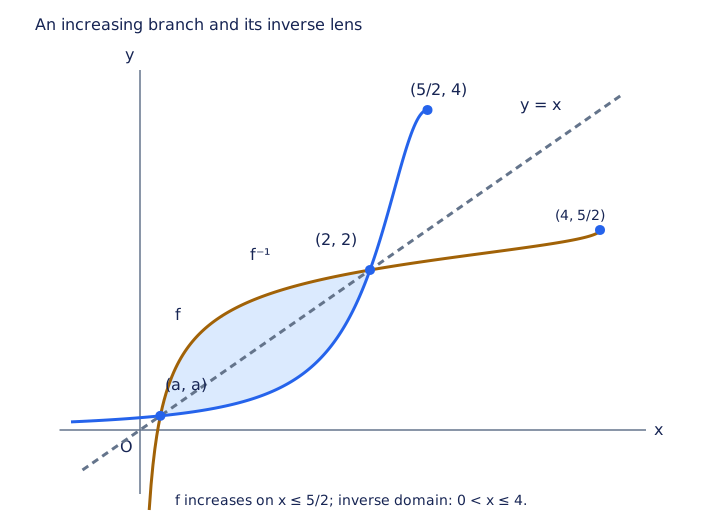
(i) Sketch and show exists.
(ii) Find and its domain.
The intersections of and have x-coordinates and , where . Find the enclosed area in terms of .
[2013/AJC/II/1]
CJC · Review problems · Question 15
Answer
, ; area .
(i) Use the restricted increasing branch
The curve increases from the horizontal asymptote as to the included endpoint , and passes through and . It is one-to-one by the horizontal-line test. For example for .
(ii) Choose the root compatible with the original domain
From and , choose . Swapping variables gives with domain . The plus branch would invert a different restriction of the original rational curve.
Use reflection in y=x for the enclosed area
The two curves reflect in ; between the intersections, lies below the diagonal. Their enclosed area is square units. The required result remains in terms of .
Compare your sketch
Expand diagramFit diagram to page
Use the scrollbars or arrow keys to inspect details.
Common mistakes
The inverse square-root sign is fixed by the original restriction x≤5/2.