Porisma

Worked solution

Use inverse symmetry to integrate only half the lens

Define f(x)=4/[(2x−5)2+1]f(x)=4/[(2x-5)^2+1] for real x≤5/2x\le5/2.

(i) Sketch y=f(x)y=f(x) and show f−1f^{-1} exists.

(ii) Find f−1(x)f^{-1}(x) and its domain.

The intersections of ff and f−1f^{-1} have x-coordinates aa and 22, where a<2a<2. Find the enclosed area in terms of aa.

[2013/AJC/II/1]

CJC · Review problems · Question 15

Answer

f−1(x)=52−124/x−1f^{-1}(x)=\tfrac52-\tfrac12\sqrt{4/x-1}, 0<x≤40<x\le4; area 4+π−a2+4tan⁡−1(2a−5)4+\pi-a^2+4\tan^{-1}(2a-5).

(i) Use the restricted increasing branch

The curve increases from the horizontal asymptote y=0y=0 as x→−∞x\to-\infty to the included endpoint (5/2,4)(5/2,4), and passes through (0,2/13)(0,2/13) and (2,2)(2,2). It is one-to-one by the horizontal-line test. For example f′(x)=−16(2x−5)/[(2x−5)2+1]2>0f^{\prime}(x)=-16(2x-5)/[(2x-5)^2+1]^2>0 for x<5/2x<5/2.

How did this part go?

(ii) Choose the root compatible with the original domain

From (2x−5)2=4/y−1(2x-5)^2=4/y-1 and x≤5/2x\le5/2, choose 2x−5=−4/y−12x-5=-\sqrt{4/y-1}. Swapping variables gives f−1(x)=5/2−124/x−1f^{-1}(x)=5/2-\tfrac12\sqrt{4/x-1} with domain (0,4](0,4]. The plus branch would invert a different restriction of the original rational curve.

How did this part go?

Use reflection in y=x for the enclosed area

The two curves reflect in y=xy=x; between the intersections, f(x)f(x) lies below the diagonal. Their enclosed area is 2∫a2[x−f(x)]dx=2[x2/2−2tan⁡−1(2x−5)]a2=4+π−a2+4tan⁡−1(2a−5)2\int_a^2[x-f(x)]dx=2[x^2/2-2\tan^{-1}(2x-5)]_a^2=4+\pi-a^2+4\tan^{-1}(2a-5) square units. The required result remains in terms of aa.

How did this part go?

Compare your sketch

Expand diagram

Use the scrollbars or arrow keys to inspect details.
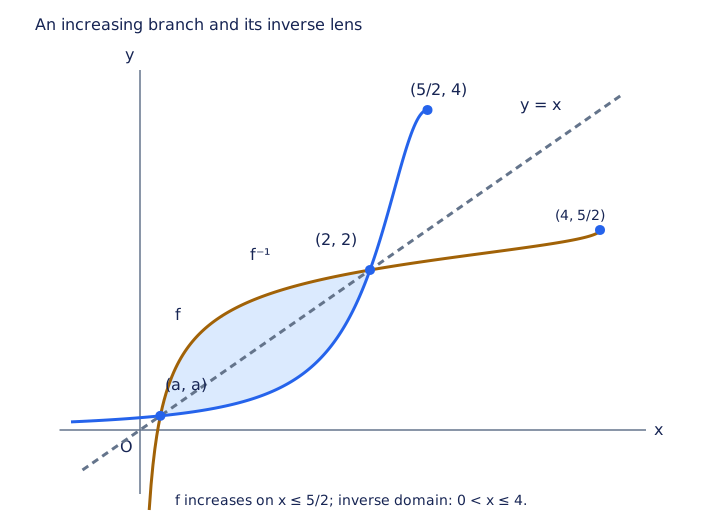
Increasing rational branch ends at (5/2,4), has horizontal asymptote y=0 and y-intercept 2/13. Its inverse is reflected across y=x; the lens between their intersections (a,a) and (2,2) is shaded.

Common mistakes

The inverse square-root sign is fixed by the original restriction x≤5/2.

Read the hint