Worked solution
Count first-winning throws and distinguish payout from net gain
A player wins by balancing a beam with three alternating items: ball–cube–ball or cube–ball–cube, as shown. An unbiased die determines each item: scores 1 or 2 give a ball; otherwise a cube. The player has at most 5 throws. An item of the same type as the last accepted item is rejected.
Let X be the number of throws required to win. Show that . marks
Find the probability of winning. marks
The entry fee is a dollars. A win on throw 3 pays back 2 a dollars, on throw 4 pays back a/2 dollars, and on throw 5 pays back a/3 dollars. Find a if the owner expects a profit of 1.20 dollars per game. marks
Expand diagramFit diagram to page
Use the scrollbars or arrow keys to inspect details.
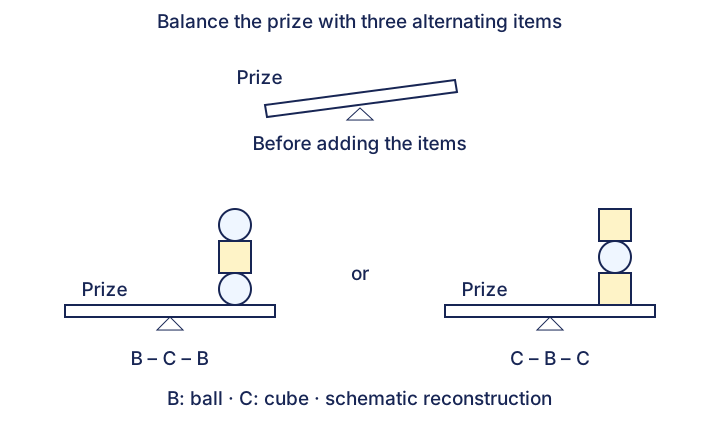
[2006/NJC/II/29(OR)]
CJC · Review problems · Question 12
Answer
; ; dollars (2 d.p.).
Read the source stacks and rejection rule
Let B denote a ball, with probability 2/6, and C a cube, with probability 4/6. Independent die throws are used. BCB or CBC are the three accepted items; repetitions of the most recently accepted type are rejected but still use a throw. The source phrase “if it is the last drawn accepted item” means the same type as that item. On losing by the five-throw limit, X has no finite winning value; probabilities below concern wins on throws 3,4,5.
Retain all four first-win-on-four paths and products
.
Each path has exactly one rejected repeated item before its third accepted item.
Retain both three-throw paths
.
Retain all six five-throw paths and products
.
Writing p=2/6 and q=4/6, their six source products in the same order are . These represent the source’s explicit factors 2/6 and 4/6, grouped into powers for repeated items.
Winning probability
.
Retain the full player net-gain table
Let Y denote the player’s net gain after subtracting the entry fee.
| y | Event | |
|---|---|---|
| a | win on throw 3 | |
| win on throw 4 | ||
| win on throw 5 | ||
| −a | no win |
Retain the owner-profit equation and rounded fee
An expected owner profit of 1.20 dollars gives . Thus . Solving gives dollars to 2 decimal places, as in the source. The unrounded solution is ; charging the rounded cent amount makes the expected profit approximately 1.20 dollars.
Common mistakes
The source prize amounts are payouts, so subtract the entry fee before constructing net gains. Stop counting a path as soon as it wins.
Solution notes
All asks/marks, initial unbalanced beam and both winning-stack panels reconstructed accessibly, complete four/ two/ six winning path lists and products, winning sum, full net-gain table and fee equation retained. Source rejection wording made explicit; losing outcome does not have a finite winning X. Exact fee supplements the source rounded answer.