Worked solution
Invert an exponential and distinguish a composite from a square
(a) The functions and are defined by
, ,
, .
(i) Find, in a similar form, and . marks
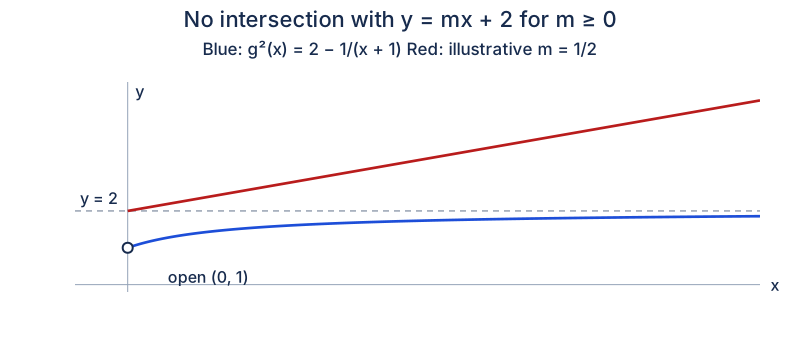
(ii) Sketch the graph of and write down the range of values of such that has no real roots for . marks
(b) The functions and , each with domain , are such that
,
.
Find the function . marks
[2010/PJC/Promo/4]
CJC · Review Problems · Question 4
Answer
(a)(i) for ; for . (ii) . (b) is valid; the equation determines this rule only on .
(a)(i)
For , . Since , choose . Thus , . For the composite, , . This is a repeated application, not .
(a)(ii)
Write for . It increases from the excluded endpoint towards the horizontal asymptote , so its range is . For , the line is at least 2 on , and cannot meet the curve. For , the line-minus-curve difference tends to 1 as and to as , so it has an intersection. The required set is .
(b)
The key rewrites , and gives , . This is a valid function satisfying the equation. There is a qualification: , so the equation forces only for . With merely the printed domain , the values of for are unrestricted. The printed global linear rule is one valid extension, not a uniquely determined answer without a further assumption.
Compare your sketch
Expand diagramFit diagram to page
Use the scrollbars or arrow keys to inspect details.
Common mistakes
A composite determines the outer function only on the range of the inner function.
Solution notes
The source global rule k(x)=2x+3 is preserved as a valid extension. Uniqueness on all real inputs is not justified by the printed assumptions; arbitrary values below 5 also satisfy the composite equation.