Porisma

Worked solution

Invert an exponential and distinguish a composite from a square

(a) The functions ff and gg are defined by

f:x↦e1−x2f:x\mapsto e^{1-x^2}, x>0x>0,

g:x↦1+xxg:x\mapsto\dfrac{1+x}{x}, x>0x>0.

(i) Find, in a similar form, f−1f^{-1} and g2g^2. marks

(ii) Sketch the graph of g2g^2 and write down the range of values of mm such that g2(x)=mx+2g^2(x)=mx+2 has no real roots for x>0x>0. marks

(b) The functions hh and kk, each with domain R\mathbb R, are such that

h:x↦(x−1)2+5h:x\mapsto(x-1)^2+5,

kh:x↦2x2−4x+15kh:x\mapsto2x^2-4x+15.

Find the function kk. marks

[2010/PJC/Promo/4]

CJC · Review Problems · Question 4

Answer

(a)(i) f−1(x)=1−ln⁡xf^{-1}(x)=\sqrt{1-\ln x} for 0<x<e0<x<e; g2(x)=(2x+1)/(x+1)g^2(x)=(2x+1)/(x+1) for x>0x>0. (ii) m≥0m\geq0. (b) k(x)=2x+3k(x)=2x+3 is valid; the equation determines this rule only on x≥5x\geq5.

(a)(i)

For y=e1−x2y=e^{1-x^2}, ln⁡y=1−x2\ln y=1-x^2. Since x>0x>0, choose x=1−ln⁡yx=\sqrt{1-\ln y}. Thus f−1:x↦1−ln⁡xf^{-1}:x\mapsto\sqrt{1-\ln x}, 0<x<e0<x<e. For the composite, g2(x)=g(g(x))=1+(1+x)/x(1+x)/x=2x+1x+1g^2(x)=g(g(x))=\dfrac{1+(1+x)/x}{(1+x)/x}=\dfrac{2x+1}{x+1}, x>0x>0. This is a repeated application, not [g(x)]2[g(x)]^2.

How did this part go?

(a)(ii)

Write g2(x)=2−1x+1g^2(x)=2-\dfrac1{x+1} for x>0x>0. It increases from the excluded endpoint (0,1)(0,1) towards the horizontal asymptote y=2y=2, so its range is (1,2)(1,2). For m≥0m\geq0, the line y=mx+2y=mx+2 is at least 2 on x>0x>0, and cannot meet the curve. For m<0m<0, the line-minus-curve difference tends to 1 as x→0+x\to0^+ and to −∞-\infty as x→∞x\to\infty, so it has an intersection. The required set is {m∈R:m≥0}\{m\in\mathbb R:m\geq0\}.

How did this part go?

(b)

The key rewrites k(h(x))=2x2−4x+15=2(x−1)2+13=2[(x−1)2+5]+3k(h(x))=2x^2-4x+15=2(x-1)^2+13=2[(x-1)^2+5]+3, and gives k:x↦2x+3k:x\mapsto2x+3, x∈Rx\in\mathbb R. This is a valid function satisfying the equation. There is a qualification: Rh=[5,∞)R_h=[5,\infty), so the equation forces k(t)=2t+3k(t)=2t+3 only for t≥5t\geq5. With merely the printed domain R\mathbb R, the values of k(t)k(t) for t<5t<5 are unrestricted. The printed global linear rule is one valid extension, not a uniquely determined answer without a further assumption.

How did this part go?

Compare your sketch

Expand diagram

Use the scrollbars or arrow keys to inspect details.
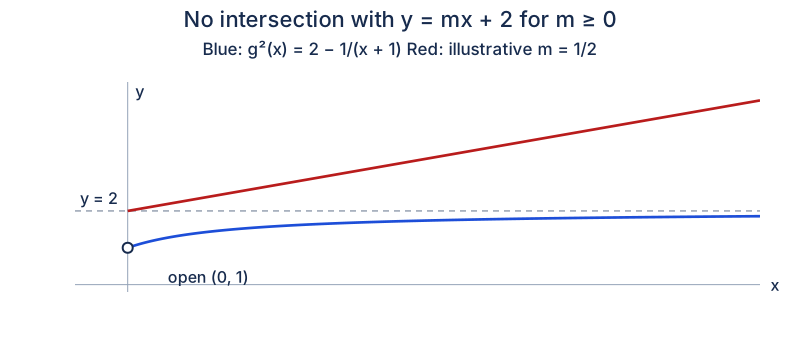
The graph y=g²(x)=2−1/(x+1) is restricted to x>0, with open endpoint (0,1) and horizontal asymptote y=2. An illustrative line y=mx+2 with m>0 lies above the curve. The no-intersection result includes m=0.

Common mistakes

A composite determines the outer function only on the range of the inner function.

Solution notes

The source global rule k(x)=2x+3 is preserved as a valid extension. Uniqueness on all real inputs is not justified by the printed assumptions; arbitrary values below 5 also satisfy the composite equation.

Read the hint