Worked solution
Use a restricted quadratic, reflection and a fixed-point condition
The function is defined by , , where and are positive constants.
(i) Show that exists. marks
(ii) State the geometrical relationship between the graphs of and . Given that the graphs of and intersect, show that . marks
(iii) Show that the composite function is defined. marks
(iv) Solve the equation . marks
[2010/TJC/Promo/12]
CJC · Review Problems · Question 5
Answer
(i) Inverse exists. (ii) Reflection in and . (iii) . (iv) No solution for positive .
(i)
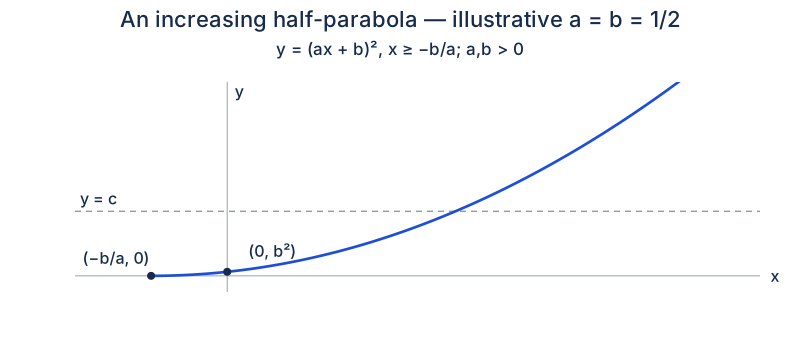
The retained right-hand branch of the parabola has vertex and is strictly increasing on . Every horizontal line cuts it at most once, so it is one-to-one and exists.
(ii)
The two graphs are reflections of one another in . Since is increasing, their common points lie on that line: . Thus , or . An intersection requires real roots, so . As , this yields .
(iii)
The range lies inside the domain , since . Therefore is defined on the whole stated domain of .
(iv)
The equation becomes . The quantity inside the square brackets is positive because , so it must equal . Therefore , and since this would require , or . This contradicts positivity of both constants. Thus there is no solution. Equivalently, the inner quantity is strictly larger than , so its square is strictly larger than .
Compare your sketch
Expand diagramFit diagram to page
Use the scrollbars or arrow keys to inspect details.
Common mistakes
The conclusion in (iv) is no admissible positive-parameter solution; b=−2a violates the given assumptions.
Solution notes
The graph uses a=b=1/2 solely as an illustration; the question retains general positive a,b.