Worked solution
Differentiate a factored cubic and distinguish a repeated stationary point
(i) Determine the turning-point coordinates for , where a,b are constants.
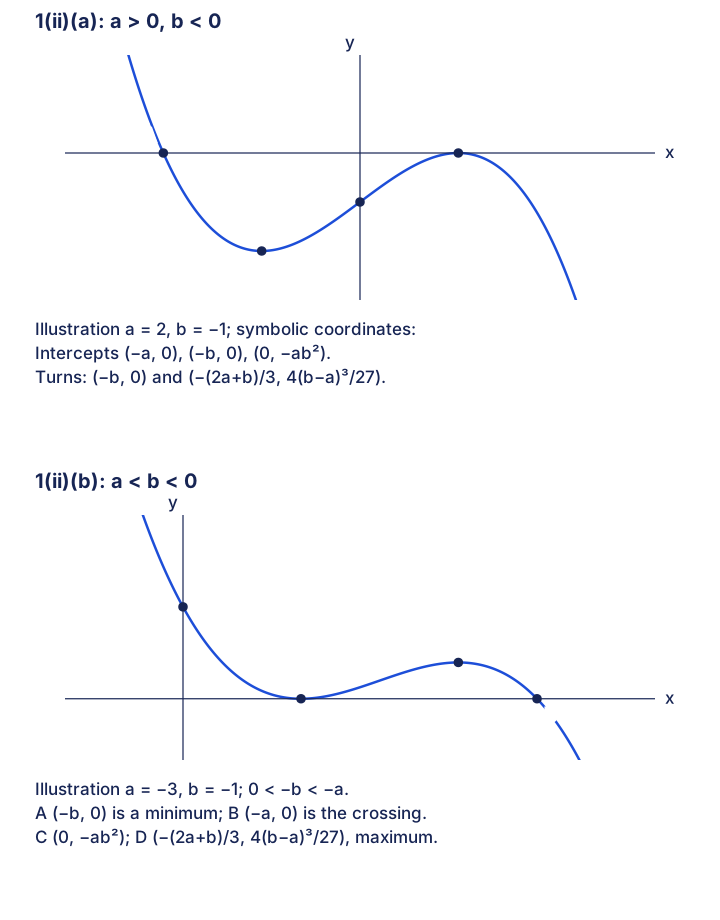
(ii) Sketch it with axial intercepts and turning points labelled when(a)a>0,b<0; and (b)a<b<0.
CJC · Review problems · Question 1
Answer
For a≠b: and . If a=b: one stationary inflection, no turn. Regime sketches shown.
(i) Differentiate the two factors
. Thus stationary inputs are or .
(i) Substitute to obtain both coordinate formulae
At x=−b,y=0. At , the source substitution gives . Thus the two coordinates are and .
(i) Check the coincident-constant case
The source calls both formulae turning points. This is correct for a≠b. If a=b, they coincide and has a stationary inflection at (−a,0), with no change of direction; it is not a turning point. Both strict regimes in(ii)have a≠b.
(ii) Identify the intercepts and ordering
All source intercepts are (0,−ab²),(−a,0),(−b,0). The double zero x=−b touches the axis and is a turn for the stated regimes; x=−a is a crossing.
(ii)(a) Opposite signs
For a>0,b<0, −a<0<−b and −ab²<0. The second stationary coordinate has negative height and is a local minimum; (−b,0) is a local maximum. The y-intercept is below the axis. The source drawing places the other turn left of the y-axis, but the assumptions do not fix that: can have either sign. The example panel shows one allowed placement.
(ii)(b) Both constants negative
For a<b<0, 0<−b<−a and −ab²>0. The source sketch has a minimum at (−b,0) and a maximum at between the two positive zeros, with a positive y-intercept. Both curves rise to the left and fall to the right.
Compare your sketch
Expand diagramFit diagram to page
Use the scrollbars or arrow keys to inspect details.
Common mistakes
A repeated zero of the derivative need not be a turning point. The source sketch in(a)does not fix every feature’s position relative to the y-axis.
Solution notes
If a=b, the stationary coordinate is an inflection rather than a turn.
The example parameter values illustrate the two regimes; the coordinate formulae apply generally.