Worked solution
Recast a quartic as a rational-curve intersection
.
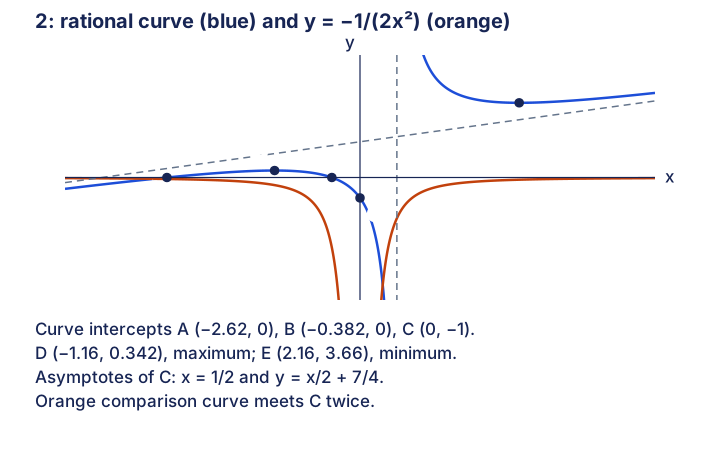
(i) Sketch C with axial intercepts, asymptotes and stationary points. marks
(ii) Add a suitable curve to deduce how many real roots has. marks
[2013/CJC/CA1/2]
CJC · Review problems · Question 2
Answer
Asymptotes x=1/2,y=x/2+7/4; all intercepts/turns shown; quartic has 2 distinct real roots.
(i) Divide and identify the graph features
. Therefore asymptotes are x=1/2 and y=x/2+7/4. Intercepts are , approximately (−2.62,0),(−0.382,0), and (0,−1). Stationary points are , maximum≈(−1.16,0.342), and , minimum≈(2.16,3.66). All source rounded labels are retained.
(ii) Rearrange without losing admissible roots
gives , hence . Neither excluded input 0 nor 1/2 is a root of the original polynomial.
(ii) Use the comparison sketch
Add to the source rational graph. It has a vertical asymptote x=0, horizontal asymptote y=0 and both branches below the x-axis. It meets C at two points, so the quartic has exactly two distinct real roots, as the source concludes.
Compare your sketch
Expand diagramFit diagram to page
Use the scrollbars or arrow keys to inspect details.
Common mistakes
The comparison introduces exclusions at 0 and 1/2; check these inputs in the original polynomial.
Solution notes
The division remainder is 11/[4(2 x−1)], as printed; exact stationary coordinates supplement the rounded labels.
The two original polynomial roots correspond to the two graph intersections.