Worked solution
Find absent output levels from a quadratic discriminant
.
(i) Without a calculator, find the range of y for which no points lie on C. marks
(ii) Sketch C with turning points, axial intercepts and asymptotes. marks
[2013/SRJC/MidYear/9(a)(modified)]
CJC · Review problems · Question 3
Answer
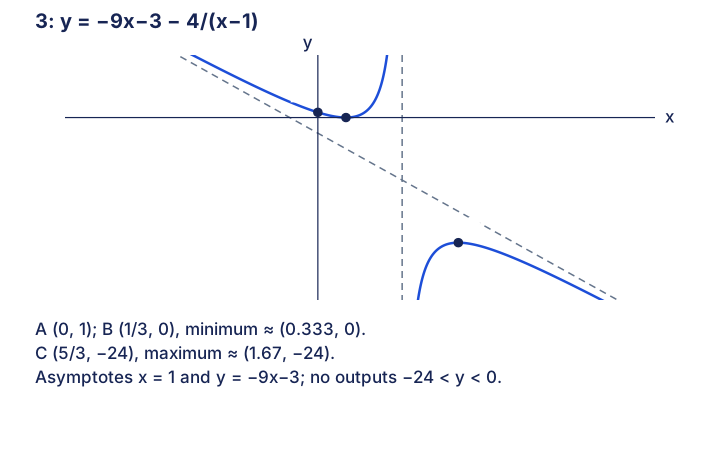
Missing outputs −24<y<0; asymptotes x=1,y=−9 x−3; turns (1/3,0),(5/3,−24); y-intercept (0,1).
(i) Intersect with a horizontal line
Write y=k. No intersection means has no real root. Thus , or . The discriminant condition is , giving , hence k(k+24)<0 and −24<k<0. Therefore the missing output interval is −24<y<0.
(ii) Divide completely
Subtract from the numerator to leave −3 x−1. Subtract to leave −4. Thus , with asymptotes x=1 and y=−9 x−3.
(ii) Label intercepts and boundary turns
The y-intercept is (0,1). The numerator is−(3 x−1)², so the x-intercept is (1/3,0), a local minimum; the source labels it(0.333,0). The other turn is a local maximum (5/3,−24), source rounding(1.67,−24). These follow from . Both boundary output values are attained.
Compare your sketch
Expand diagramFit diagram to page
Use the scrollbars or arrow keys to inspect details.
Common mistakes
The output interval is open because both endpoints occur on the curve.
Solution notes
The rounded source turns are given exactly as 1/3 and 5/3 in the working.
The excluded input x=1 does not create an extra solution when forming the quadratic.