Worked solution
Use a cosine amplitude bound that works for every phase and frequency
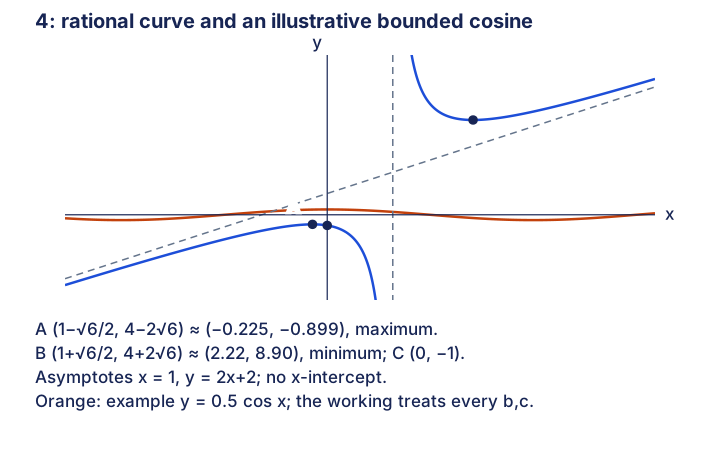
Sketch with all turning points, axial intercepts and asymptotes. Hence state the values of a for which , x≠1, has no real solution for all b,c. marks
[2010/RI(JC)/Promo/3]
CJC · Review problems · Question 4
Answer
Exact amplitude range ; source rounded bounds approximately −0.899<a<0.899.
Divide and find the graph features
, with asymptotes x=1 and y=2 x+2. There is no x-intercept since 2 x²+1>0; the y-intercept is (0,−1). The turns are , maximum≈(−0.225,−0.899), and , minimum≈(2.22,8.90), retaining the source labels.
Compare with a bounded cosine
Dividing the equation by x−1 gives . The source instructs sketching the cosine on the rational graph. For any b,c, its outputs lie in[−|a|,|a|]. The rational curve has outputs y≤4−2√6 or y≥4+2√6. Thus the symmetric cosine band avoids it if .
Keep the exact strict boundary
The exact range is . The source writes −0.899<a<0.899 using the rounded maximum magnitude; these are approximate boundary labels, not exact endpoints. At |a|=2√6−4 one can choose a phase giving the rational curve’s maximum; for larger |a|one can also choose b=0 and a phase attaining an available negative output. Therefore the strict bound is necessary for the guarantee for all b,c.
Compare your sketch
Expand diagramFit diagram to page
Use the scrollbars or arrow keys to inspect details.
Common mistakes
Keep the exact endpoints when stating a strict parameter range; rounding can admit forbidden values.
Solution notes
The source decimal endpoints are rounded versions of the exact strict bounds.
The cosine plotted is only an illustration; the amplitude argument covers every b,c.