Worked solution
Find a rational range and solve by adding a cosine sketch
.
(i) Find exactly the values of y for which C does not lie. marks
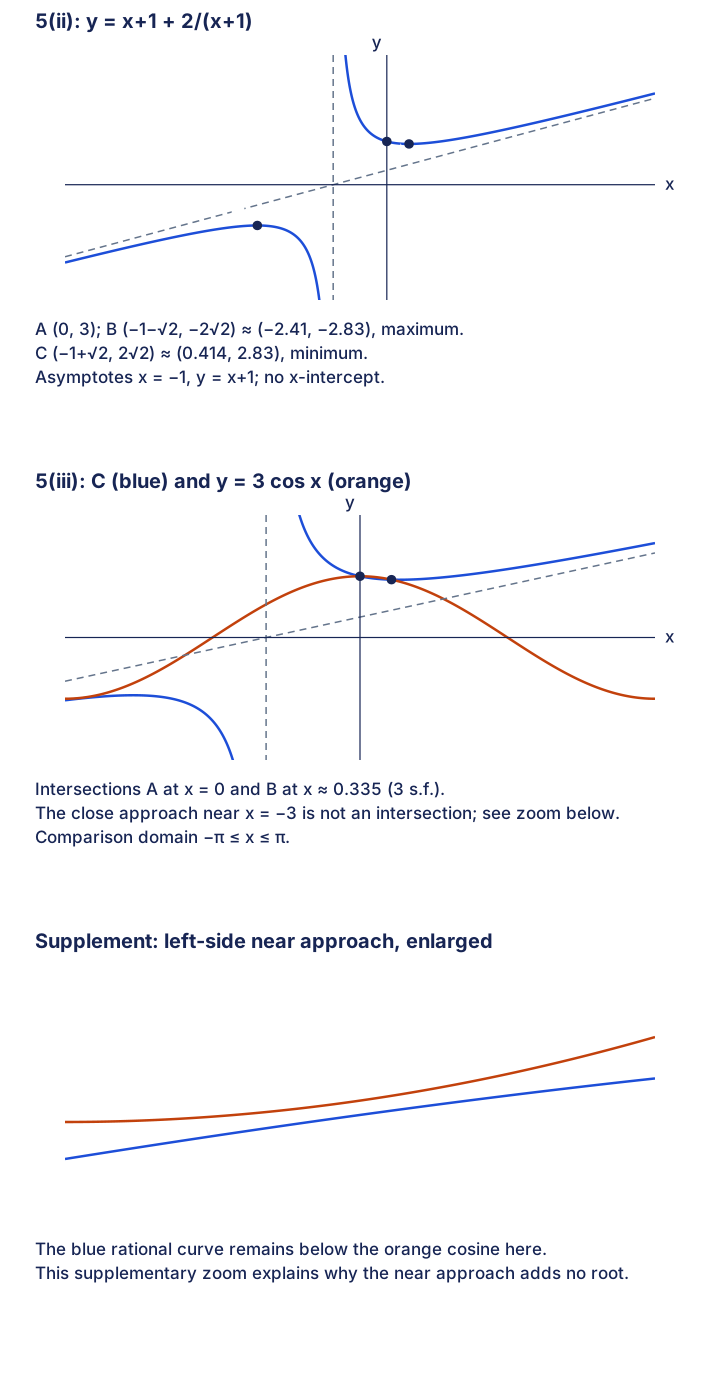
(ii) Sketch C with axial intercept, asymptotes and stationary points. marks
(iii) Add a sketch on−π≤x≤πto solve . marks
[2013/MI/I/6]
CJC · Review problems · Question 5
Answer
Missing outputs ; turns ; cosine solutions x=0 and x≈0.335 (3 s.f.).
(i) Form and analyse the horizontal-level quadratic
gives . No roots requires . Thus , or , hence . Therefore the missing interval is .
(ii) Divide and label both branches
, so asymptotes are x=−1,y=x+1. The only axial intercept is (0,3), since the numerator (x+1)²+2 has no real zero. The turns are , maximum≈(−2.41,−2.83), and , minimum≈(0.414,2.83). All source rounded coordinates are retained.
(iii) Rearrange into the given curve
gives . x=−1 is not a solution of the original equation, so division does not lose a root.
(iii) Read the two intersections in the specified interval
Add y=3 cosx on−π≤x≤π. The source concludes x=0 or x≈0.335 to 3 significant figures. Both are retained. The left branches approach closely near x=−3 but do not cross; the supplementary zoom keeps that near approach from being mistaken for an additional solution.
Compare your sketch
Expand diagramFit diagram to page
Use the scrollbars or arrow keys to inspect details.
Common mistakes
The graph comparison is restricted to−π≤x≤π; a close approach is not necessarily an intersection.
Solution notes
Both source solutions and the exact missing-output interval are retained.
The enlarged left-side view is a supplementary explanation, not an additional source panel.