Worked solution
Check a cancellation exception before claiming a strict parameter range
· Techniques of Differentiation
, where k is constant.
(i) Given no stationary point, show that k>1. marks
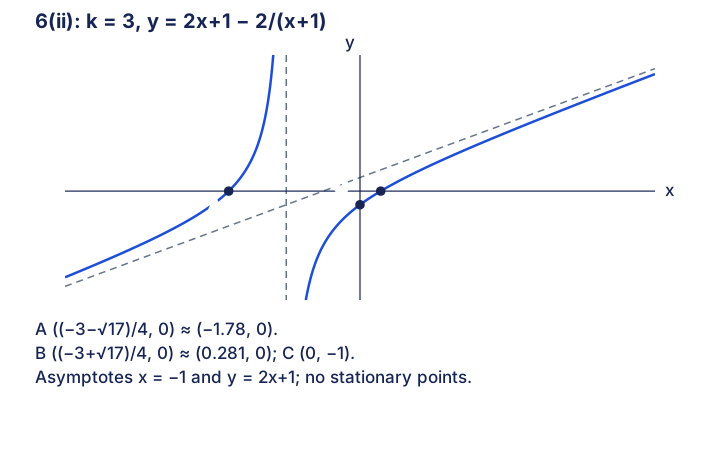
(ii) Given y=2 x+1 is an asymptote, show k=3 and sketch G. marks
[2015/VJC/MYE/8(part)]
CJC · Review problems · Question 6
Answer
(i)Literal condition k≥1; source intended non-cancellation target k>1. (ii)k=3; full graph shown.
(i) Differentiate and correct the intermediate sign
. The source prints 1−kin one intermediate numerator; its subsequent completed-square form and discriminant use the correct 1+k.
(i) Reproduce the intended nondegenerate argument
The source sets and excludes real roots by requiring . Thus 1+k>2 and k>1. This correctly gives the range with no real numerator roots.
(i) Explain why the printed implication needs qualification
At k=1, the numerator factors as(2 x−1)(x+1), so G is y=2 x−1 with x=−1 removed. Its derivative is 2 everywhere in its domain, hence it also has no stationary point. For k<1 there are two admissible derivative zeros. Thus the literal no-stationary-point condition is k≥1; the printed target k>1 is valid only if the cancellation case is excluded. The prompt does not explicitly exclude it.
(ii) Compare coefficients with the given asymptote
The source writes , calling the remainder r by the auxiliary letter a. Compare with the original numerator: k=3 and 1+r=−1, so r=−2. Hence .
(ii) Label the complete graph
Asymptotes are x=−1 and y=2 x+1. Intercepts are , approximately (−1.78,0),(0.281,0), and (0,−1). The derivative is , so no stationary points occur.
Compare your sketch
Expand diagramFit diagram to page
Use the scrollbars or arrow keys to inspect details.
Common mistakes
Do not silently discard k=1: it gives a valid line with a hole and no stationary points.
Solution notes
The source 1−kintermediate sign is corrected to 1+k.
The printed k>1 target omits the valid cancellation case k=1; the literal condition is k≥1.