Worked solution
Use completing the square before drawing a rational graph
where and b,c are real constants. C has oblique asymptote y=x−5.
(i) Find b. marks
(ii) Given c>9, show C does not cut the x-axis. mark
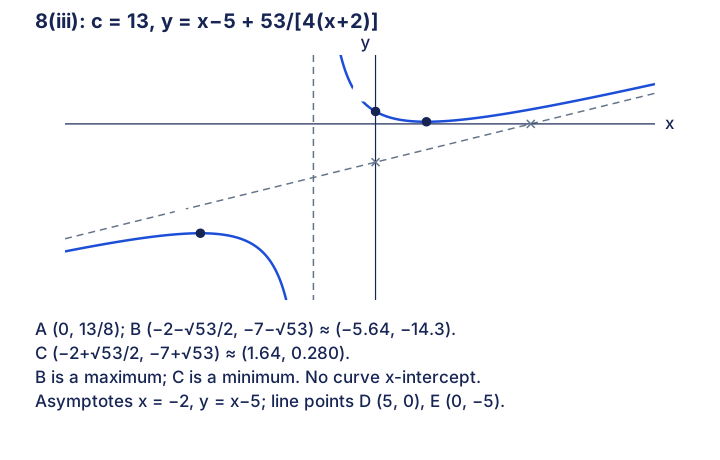
(iii) For c=13 sketch C, clearly indicating asymptotes, axial intercepts and turning points. marks
[2012/SRJC/Promo/8]
CJC · Review problems · Question 8
Answer
b=−12; no x-intercept for c>9; the c=13 graph has the labelled asymptotes and turns.
(i) Divide and compare the constant term
. The oblique asymptote is . Hence , so b=−12.
(ii) Complete the square in the numerator
For c>9, for every real x. Therefore the numerator never vanishes and C does not cut the x-axis; x=−2 is excluded from its domain.
(iii) Label the two branches for c=13
. Asymptotes: x=−2 and y=x−5. The y-intercept is (0,13/8). Stationary points are , a maximum≈(−5.64,−14.3), and , a minimum≈(1.64,0.280). These retain the source rounded labels. The source also marks (5,0) and (0,−5) on the oblique asymptote: these belong to the line, not the curve.
Compare your sketch
Expand diagramFit diagram to page
Use the scrollbars or arrow keys to inspect details.
Common mistakes
Do not mistake the dashed asymptote’s x-intercept for an intercept of C.
Solution notes
The labelled (5,0) and (0,−5) belong to the oblique asymptote.