Worked solution
Recover the curve from its range and count line intersections
, where a is a non-zero constant. C exists for y≤−2 or y≥b, where b is positive.
(i) Using an analytical method, show a=−2 and hence find b. marks
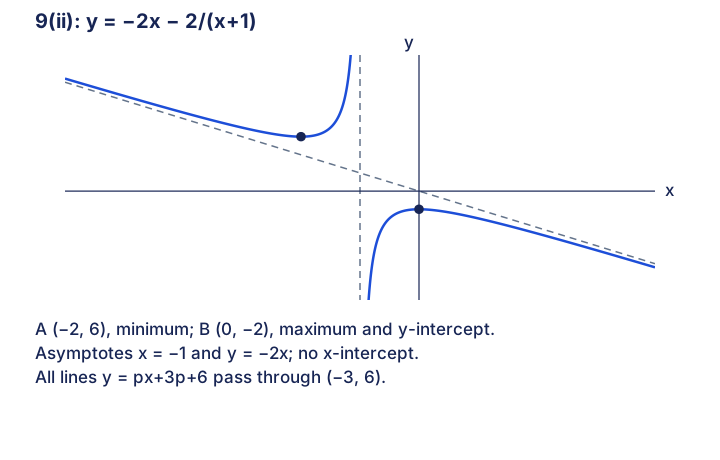
(ii) Sketch C, clearly showing turning-point coordinates and asymptotes. marks
(iii) Show(−3,6) lies on y=px+3 p+6 for every real p. Hence use the sketch in(ii) to find p for which has two distinct real roots. marks
[2015/SRJC/MYE/9]
CJC · Review problems · Question 9
Answer
a=−2, b=6; the line family meets C twice exactly for p>0 or p<−2.
(i) Express the range condition through a discriminant
gives . At least one real x requires , hence . Since a≠0, x=−1 does not satisfy the rearranged equation, so this criterion respects the domain.
(i) Compare coefficients with the given boundary levels
The supplied range y≤−2 or y≥b is equivalent to . Expanding gives . Comparing with yields −4=2−b and 4+8 a=−2 b. Thus b=6 and .
(ii) Divide and mark all graph features
For a=−2, divide −2 x²−2 x−2 by x+1. The quotient is −2 x; subtracting −2 x(x+1)=−2 x²−2 x leaves remainder −2. Thus . The asymptotes are x=−1 and y=−2 x. Stationary points are (−2,6), a minimum, and (0,−2), a maximum also giving the y-intercept. The numerator −2(x²+x+1) has no real zero, so there is no x-intercept.
(iii) Locate the common point and read two intersections
At x=−3, . Thus every line y=px+3 p+6 passes through (−3,6). As in the source sketch argument, two distinct intersections with C occur precisely when p>0 or p<−2.
(iii) Check the boundary slopes algebraically
As a supplementary check, multiplication by x+1 gives . Its discriminant is , positive exactly for p>0 or p<−2. p=−2 reduces to the impossible equation 2=0; p=0 gives the double intersection x=−2. Substituting x=−1 gives 2, so no counted root is an excluded input.
Compare your sketch
Expand diagramFit diagram to page
Use the scrollbars or arrow keys to inspect details.
Common mistakes
Check p=−2 separately: the quadratic loses its leading term at that boundary.
Solution notes
The algebraic intersection check supplements the source’s sketch argument.