Worked solution
Test a revision-time claim and find a minimum sample size
A teacher claims that the average time a student spends on mathematics revision per day is 120 minutes. A random sample of 150 students is observed and the time, min, that each student spends on mathematics revision per day noted. It is found that
(i) Test, at the 1% level of significance, whether the teacher has overstated the average time spent on mathematics revision per day by a student. marks
(ii) Using the unbiased estimate of the population variance in (i), what is the least number of students that is required in a sample whose mean is 110 hours to arrive at a different conclusion from that in part (i)? marks
[2009/NYJC/II/7(a)(modified)]
CJC · Review problems · Question 1
Answer
min, ; , : do not reject at 1%. Intended part (ii), with 110 minutes: minimum .
(i) Estimate the mean and variance
minutes. The unbiased variance estimate is
(i) Hypotheses and p-value method
Let be the population mean daily revision time in minutes. Test against . With the large random sample, under , by the CLT, using the estimated variance. Thus The left-tail p-value is . Do not reject : there is insufficient evidence at 1% that the teacher overstated the mean. The source calculator workflow is Z-Test, Stats, null mean 120, estimated standard deviation , sample mean 110, n 150, alternative less-than; it displays z≈−2.236067977 and p≈.0126736174.
(i) Critical-value method
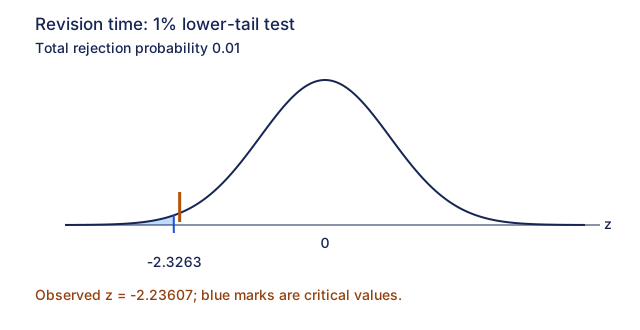
The 1% lower-tail critical value is . Reject when . Since is to the right of this boundary, the same non-rejection conclusion follows. The comparison diagram shades the 1% rejection tail.
(ii) Interpret the inconsistent unit before solving
The printed “110 hours” conflicts with all the minute-based data and the source working. To reproduce the intended question, take the new mean to be 110 minutes and retain the 1% level and . Rejection requires Therefore , so the least integer is . At n 162, p≈.01007; at n 163, p≈.00988, straddling .01. If 110 hours were literal, the mean would be 6600 minutes and could never reject in this lower-tail direction;163 is conditional on the intended minute unit.
Compare your sketch
Expand diagramFit diagram to page
Use the scrollbars or arrow keys to inspect details.
Common mistakes
Do not silently convert a printed unit error into a different test. The source result 163 assumes 110 minutes, not 110 hours.
Solution notes
Printed question (ii) says 110 hours; intended unit is minutes, as shown by its working. Source statistic numerator says Xbar−300 rather than Xbar−120; source critical-method headings say 10% although the tail, critical value and requested test are 1%. These slips are recorded rather than propagated. Source n-bound 162.35 uses rounded critical values.