Worked solution
Invert a two-sided test without imposing integer means
A random sample of 50 packets of ‘Nilo Bar’ snacks is weighed and the mass, grams, is recorded. The results are summarised by
The population mean mass is grams. A test is carried out at the 1% significance level with the following hypotheses:
Given that is rejected in favour of , find the set of possible values of . marks
[2009/IJC/II/10(b)]
CJC · Review problems · Question 2
Answer
or (exact boundaries in working). Source integer-cutoff final set is too restrictive for real-valued means.
Estimate the sampling variance
. The unbiased variance is Under , by the large-sample normal approximation.
Use both rejection tails
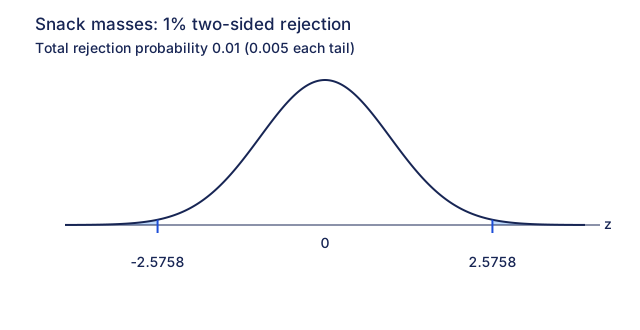
The two-sided 1% test rejects if The critical magnitude is , giving or . Keep the exact expression for boundary decisions.
Compare the printed final set
The source working gives boundaries 142.823 and 147.1769, but its final set says or while declaring . That final set discards valid real values between 142 and 142.823 or 147.177 and 148. It would follow only with an additional integer restriction, which the question does not state. The real-valued rejection set above is the intended statistical calculation; the source final answer is retained here as a qualified discrepancy.
Compare your sketch
Expand diagramFit diagram to page
Use the scrollbars or arrow keys to inspect details.
Common mistakes
Population means need not be integers even when observations are discrete; here packet masses are not restricted to integers either.
Solution notes
Source page 4 reverses an inequality sign in an intermediate line. Its final integer cutoffs conflict with its own real-valued domain. Correct inequalities and exact critical-value boundaries are shown, while both printed numeric stages are retained.