Porisma

Worked solution

Reverse an arctangent chain and use a principal sine substitution

(i) Find ∫etan⁡−12x1+4x2 dx\displaystyle\int\dfrac{e^{\tan^{-1}2x}}{1+4x^2}\,dx. marks

(ii) Given that −π2<θ<π2-\dfrac\pi2<\theta<\dfrac\pi2, use the substitution x=sin⁡θx=\sin\theta to find ∫x21−x2 dx\displaystyle\int\dfrac{x^2}{\sqrt{1-x^2}}\,dx. marks

[2018/MI/Promo/PU2/I/9]

CJC · Review Problems · Question 10

Answer

(i) 12etan⁡−12x+C\frac12e^{\tan^{-1}2x}+C; (ii) 12[sin⁡−1x−x1−x2]+C\frac12[\sin^{-1}x-x\sqrt{1-x^2}]+C.

(i)

The inner derivative is ddx(tan⁡−12x)=2/(1+4x2)\dfrac d{dx}(\tan^{-1}2x)=2/(1+4x^2). Hence the integral is 12etan⁡−12x+C\frac12 e^{\tan^{-1}2x}+C.

How did this part go?

(ii)

Let x=sin⁡θx=\sin\theta and dx=cos⁡θ dθdx=\cos\theta\,d\theta. The stated interval gives cos⁡θ>0\cos\theta>0, so 1−sin⁡2θ=∣cos⁡θ∣=cos⁡θ\sqrt{1-\sin^2\theta}=|\cos\theta|=\cos\theta. The transformed integral is ∫sin⁡2θ dθ=12∫(1−cos⁡2θ)dθ=12[θ−12sin⁡2θ]+C\int\sin^2\theta\,d\theta=\frac12\int(1-\cos2\theta)d\theta=\frac12[\theta-\frac12\sin2\theta]+C. Using θ=sin⁡−1x\theta=\sin^{-1}x and cos⁡θ=1−x2\cos\theta=\sqrt{1-x^2} gives 12[sin⁡−1x−x1−x2]+C\frac12[\sin^{-1}x-x\sqrt{1-x^2}]+C. The printed triangle illustrates these ratios for positive x; the signed sine identity also covers negative x in the stated interval.

How did this part go?

Compare your sketch

Expand diagram

Use the scrollbars or arrow keys to inspect details.
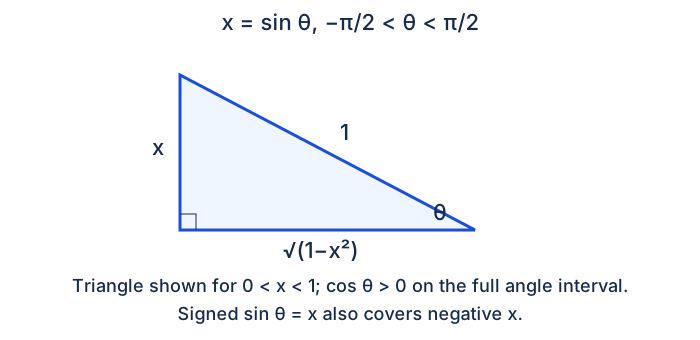
Reference right triangle for 0<x<1: opposite side x, adjacent side √(1−x²), hypotenuse 1, angle theta with sin theta=x and cos theta=√(1−x²). The full substitution permits negative theta and x; the cosine stays positive on (−π/2,π/2), so the stated identities hold there with signed sine.

Common mistakes

The reference triangle has nonnegative side lengths; signed θ handles negative x without changing cosθ>0.

Read the hint