Worked solution
Compare a cubic approximation with the actual function
Let .
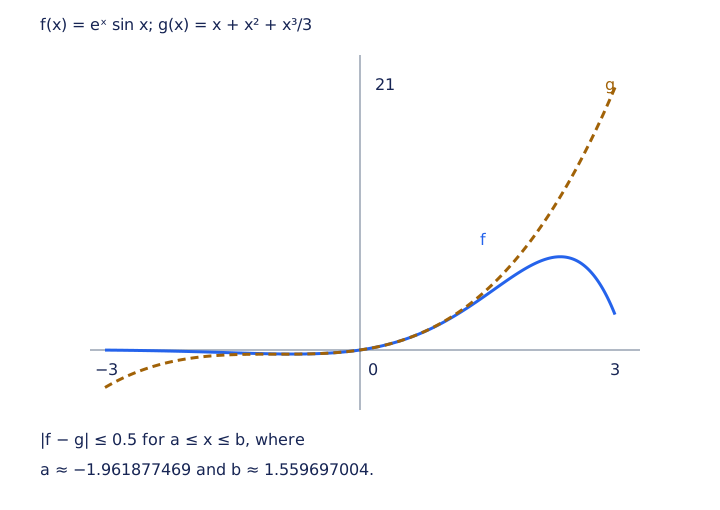
(i) Sketch for . marks
(ii) Expand through and call that polynomial . marks
(iii) On the same diagram sketch and clearly label . mark
(iv) For , find where is within of . marks
[2008/II/1]
CJC · Review problems · Question 10
Answer
. With , , strict error below means ; include the endpoints for error at most .
(i) Read the true exponential–sine shape
crosses the origin, has a shallow negative minimum at , then rises to a maximum at before falling towards its value at . This follows from . The humped positive branch is , not the polynomial.
(ii) Form the cubic polynomial
. Thus .
(iii) Label the two different shapes correctly
, so is increasing with a stationary inflection at . It reaches , while turns down after . The source drawing swaps its f/g labels; the public reconstruction plots the actual formulas and corrects those labels. The original source drawing remains unchanged in the evidence archive.
(iv) Solve the actual error condition before rounding
Let . Solving and in the given domain gives , . The strict condition holds for ; if “within” includes equality, holds for .
The source reports the rounded open interval . Its displayed error expression mistakenly uses , although part (ii) defines with ; the numerical bounds correspond to the correct cubic. Use the unrounded roots when classifying a value very close to a boundary.
Compare your sketch
Expand diagramFit diagram to page
Use the scrollbars or arrow keys to inspect details.
Common mistakes
Use x³/3 from the expansion, not the source’s later factorial typo.