Porisma

Worked solution

Compare a cubic approximation with the actual function

Let f(x)=exsin⁡xf(x)=e^x\sin x.

(i) Sketch ff for −3≤x≤3-3\le x\le3. marks

(ii) Expand ff through x3x^3 and call that polynomial g(x)g(x). marks

(iii) On the same diagram sketch and clearly label gg. mark

(iv) For −3≤x≤3-3\le x\le3, find where g(x)g(x) is within ±0.5\pm0.5 of f(x)f(x). marks

[2008/II/1]

CJC · Review problems · Question 10

Answer

g=x+x2+x3/3g=x+x^2+x^3/3. With a≈−1.96187746881a\approx-1.96187746881, b≈1.55969700385b\approx1.55969700385, strict error below 0.50.5 means a<x<ba<x<b; include the endpoints for error at most 0.50.5.

(i) Read the true exponential–sine shape

ff crosses the origin, has a shallow negative minimum at x=−π/4x=-\pi/4, then rises to a maximum at x=3π/4x=3\pi/4 before falling towards its value at 33. This follows from f′=ex(sin⁡x+cos⁡x)f^{\prime}=e^x(\sin x+\cos x). The humped positive branch is ff, not the polynomial.

How did this part go?

(ii) Form the cubic polynomial

exsin⁡x=(1+x+x2/2+⋯ )(x−x3/6+⋯ )=x+x2+x3/3+⋯e^x\sin x=(1+x+x^2/2+\cdots)(x-x^3/6+\cdots)=x+x^2+x^3/3+\cdots. Thus g(x)=x+x2+x3/3g(x)=x+x^2+x^3/3.

How did this part go?

(iii) Label the two different shapes correctly

g′(x)=(x+1)2≥0g^{\prime}(x)=(x+1)^2\ge0, so gg is increasing with a stationary inflection at (−1,−1/3)(-1,-1/3). It reaches g(3)=21g(3)=21, while ff turns down after 3π/43\pi/4. The source drawing swaps its f/g labels; the public reconstruction plots the actual formulas and corrects those labels. The original source drawing remains unchanged in the evidence archive.

How did this part go?

(iv) Solve the actual error condition before rounding

Let E(x)=f(x)−g(x)E(x)=f(x)-g(x). Solving E(a)=0.5E(a)=0.5 and E(b)=−0.5E(b)=-0.5 in the given domain gives a≈−1.96187746881a\approx-1.96187746881, b≈1.55969700385b\approx1.55969700385. The strict condition ∣E(x)∣<0.5|E(x)|<0.5 holds for a<x<ba<x<b; if “within” includes equality, ∣E(x)∣≤0.5|E(x)|\le0.5 holds for a≤x≤ba\le x\le b.

The source reports the rounded open interval −1.96<x<1.56-1.96<x<1.56. Its displayed error expression mistakenly uses x3/3!x^3/3!, although part (ii) defines gg with x3/3x^3/3; the numerical bounds correspond to the correct cubic. Use the unrounded roots when classifying a value very close to a boundary.

How did this part go?

Compare your sketch

Expand diagram

Use the scrollbars or arrow keys to inspect details.
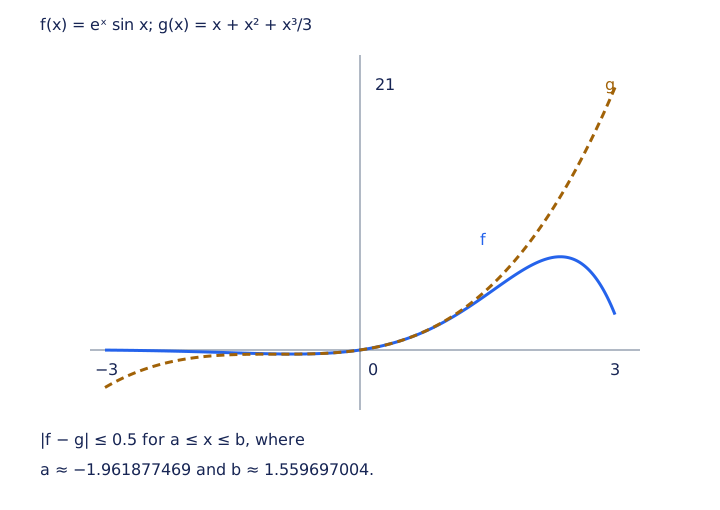
On −3 ≤ x ≤ 3, f(x)=exp(x) sin(x), solid blue, peaks at 3π/4 and then turns down. The dashed brown cubic g(x)=x+x²+x³/3 increases to 21 at x=3. The error magnitude is at most 0.5 between a≈−1.961877469 and b≈1.559697004. The source graph labels and later factorial typo are corrected.

Common mistakes

Use x³/3 from the expansion, not the source’s later factorial typo.

Read the hint