Porisma

Worked solution

Derive an ellipse tangent without losing its vertical cases

The curve CC has x=2cos⁡tx=2\cos t, y=sin⁡ty=\sin t, 0≤t<2π0\le t<2\pi.

(i) Find its cartesian equation. marks

(ii) Sketch CC. marks

(iii) Show that the tangent at the point with parameter tt is (cos⁡t)x+(2sin⁡t)y=2(\cos t)x+(2\sin t)y=2. marks

(iv) Hence find the tangents at PP, where t=7π/6t=7\pi/6, and QQ, where t=11π/6t=11\pi/6. marks

[2017/RVHS/Promo/12(part)]

CJC · Review problems · Question 7

Answer

x2/4+y2=1x^2/4+y^2=1; tangent (cos⁡t)x+(2sin⁡t)y=2(\cos t)x+(2\sin t)y=2. At PP: y=−2−3x/2y=-2-\sqrt3x/2; at QQ: y=3x/2−2y=\sqrt3x/2-2.

(i) Use the unit-circle identity

cos⁡t=x/2\cos t=x/2 and sin⁡t=y\sin t=y, so x2/4+y2=1x^2/4+y^2=1. The half-open parameter interval traces the complete ellipse once; (2,0)(2,0) is included at t=0t=0.

How did this part go?

(ii) Sketch the full ellipse

The ellipse is centred at the origin, with intercepts (±2,0)(\pm2,0) and (0,±1)(0,\pm1). Increasing tt traces it counterclockwise from (2,0)(2,0).

How did this part go?

(iii) Derive and extend the tangent equation

For sin⁡t≠0\sin t\ne0, the derivative is dy/dx=−cos⁡t/(2sin⁡t)dy/dx=-\cos t/(2\sin t). At (2cos⁡t,sin⁡t)(2\cos t,\sin t), multiply y−sin⁡t=−[cos⁡t/(2sin⁡t)](x−2cos⁡t)y-\sin t=-[\cos t/(2\sin t)](x-2\cos t) to obtain (cos⁡t)x+(2sin⁡t)y=2(cos⁡2t+sin⁡2t)=2(\cos t)x+(2\sin t)y=2(\cos^2t+\sin^2t)=2. At t=0,πt=0,\pi, the slope division is invalid but the velocity is vertical and the same formula gives x=2x=2 and x=−2x=-2, respectively.

How did this part go?

(iv) Substitute the two angles

At PP, cos⁡(7π/6)=−3/2\cos(7\pi/6)=-\sqrt3/2 and 2sin⁡(7π/6)=−12\sin(7\pi/6)=-1, giving y=−2−(3/2)xy=-2-(\sqrt3/2)x. At QQ, cos⁡(11π/6)=3/2\cos(11\pi/6)=\sqrt3/2 and 2sin⁡(11π/6)=−12\sin(11\pi/6)=-1, giving y=(3/2)x−2y=(\sqrt3/2)x-2.

How did this part go?

Compare your sketch

Expand diagram

Use the scrollbars or arrow keys to inspect details.
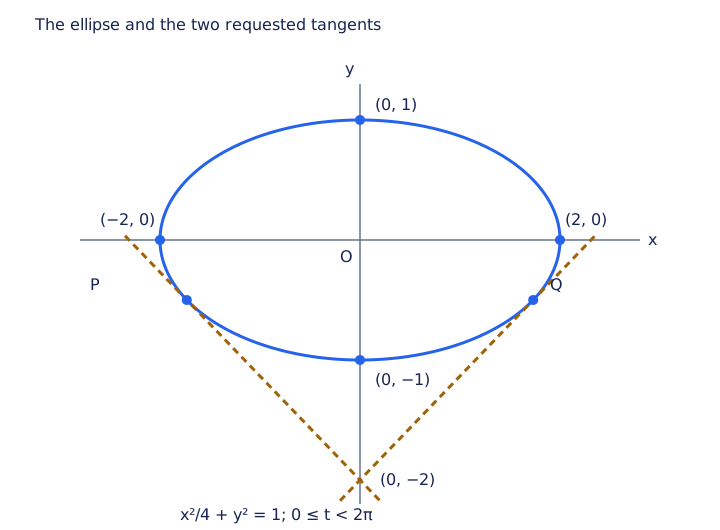
Complete ellipse x squared over four plus y squared equals one, with intercepts (±2,0) and (0,±1). Tangents at P=(−sqrt(3),−1/2) and Q=(sqrt(3),−1/2) meet at (0,−2).

Common mistakes

The compact tangent equation remains valid at vertical tangents even though a finite slope formula does not.

Read the hint