Porisma

Worked solution

Obtain a tangent-intercept triangle and qualify its endpoint

A curve has x=cos⁡2tx=\cos^2t, y=sin⁡3ty=\sin^3t, 0≤t≤π/20\le t\le\pi/2.

(i) Sketch the curve. marks

(ii) The tangent at (cos⁡2θ,sin⁡3θ)(\cos^2\theta,\sin^3\theta) meets the x- and y-axes at QQ and RR respectively. With OO the origin, show that the area of triangle OQROQR is 112sin⁡θ(3cos⁡2θ+2sin⁡2θ)2\tfrac1{12}\sin\theta(3\cos^2\theta+2\sin^2\theta)^2. The source repeats the interval using tt; the tangent parameter is θ\theta. marks

[2007/I/11]

CJC · Review problems · Question 9

Answer

Area =112sin⁡θ(3cos⁡2θ+2sin⁡2θ)2=\tfrac1{12}\sin\theta(3\cos^2\theta+2\sin^2\theta)^2 for 0<θ≤π/20<\theta\le\pi/2, with degenerate limit zero at θ=0\theta=0.

(i) Sketch the restricted first-quadrant curve

y=(1−x)3/2y=(1-x)^{3/2} for 0≤x≤10\le x\le1. The curve joins the included endpoints (1,0)(1,0) and (0,1)(0,1), decreasing and convex as a graph of xx. As tt increases, it runs from (1,0)(1,0) to (0,1)(0,1).

How did this part go?

(ii) Form the tangent, including the endpoint limits

dx/dt=−2cos⁡tsin⁡tdx/dt=-2\cos t\sin t and dy/dt=3sin⁡2tcos⁡tdy/dt=3\sin^2t\cos t. In the interior, dy/dx=−3sin⁡t/2dy/dx=-3\sin t/2, so the tangent is y−sin⁡3θ=−32sin⁡θ(x−cos⁡2θ)y-\sin^3\theta=-\tfrac32\sin\theta(x-\cos^2\theta). The one-sided Cartesian derivative gives the same expression at both endpoints, although both parameter derivatives vanish there.

How did this part go?

(ii) Locate each intercept

For 0<θ≤π/20<\theta\le\pi/2, putting y=0y=0 gives Q=(cos⁡2θ+23sin⁡2θ,0)Q=(\cos^2\theta+\tfrac23\sin^2\theta,0). Putting x=0x=0 gives R=(0,32sin⁡θcos⁡2θ+sin⁡3θ)R=(0,\tfrac32\sin\theta\cos^2\theta+\sin^3\theta). Write A=3cos⁡2θ+2sin⁡2θA=3\cos^2\theta+2\sin^2\theta; the positive intercept lengths are OQ=A/3OQ=A/3 and OR=(sin⁡θ)A/2OR=(\sin\theta)A/2.

How did this part go?

(ii) Multiply the intercept lengths and state the degenerate case

The area is 12(A/3)[(sin⁡θ)A/2]=112sin⁡θ(3cos⁡2θ+2sin⁡2θ)2\tfrac12(A/3)[(\sin\theta)A/2]=\tfrac1{12}\sin\theta(3\cos^2\theta+2\sin^2\theta)^2, as required. At θ=0\theta=0, the tangent is the x-axis itself, so its x-axis intersection QQ is not unique and a nondegenerate triangle is not defined. The printed formula has limit zero there; it is interpreted as the degenerate limiting area, not as a unique pair of tangent intercepts.

How did this part go?

Compare your sketch

Expand diagram

Use the scrollbars or arrow keys to inspect details.
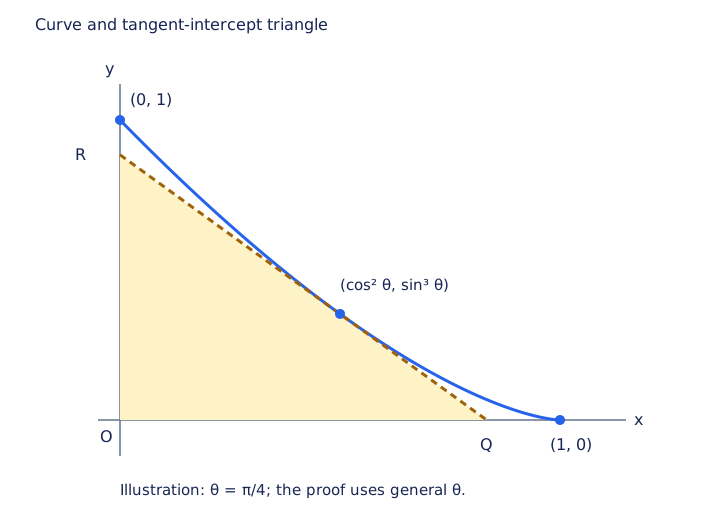
Convex decreasing curve y=(1−x) to the power 3/2 joins filled endpoints (0,1) and (1,0). An illustrative tangent at theta=pi/4 passes through (1/2, sqrt(2)/4) and meets the axes at Q=(5/6,0), R=(0,5sqrt(2)/8), forming triangle OQR.

Common mistakes

At theta zero the tangent coincides with the x-axis, so its x-intercept is not uniquely defined.

Read the hint