Worked solution
Obtain a tangent-intercept triangle and qualify its endpoint
A curve has , , .
(i) Sketch the curve. marks
(ii) The tangent at meets the x- and y-axes at and respectively. With the origin, show that the area of triangle is . The source repeats the interval using ; the tangent parameter is . marks
[2007/I/11]
CJC · Review problems · Question 9
Answer
Area for , with degenerate limit zero at .
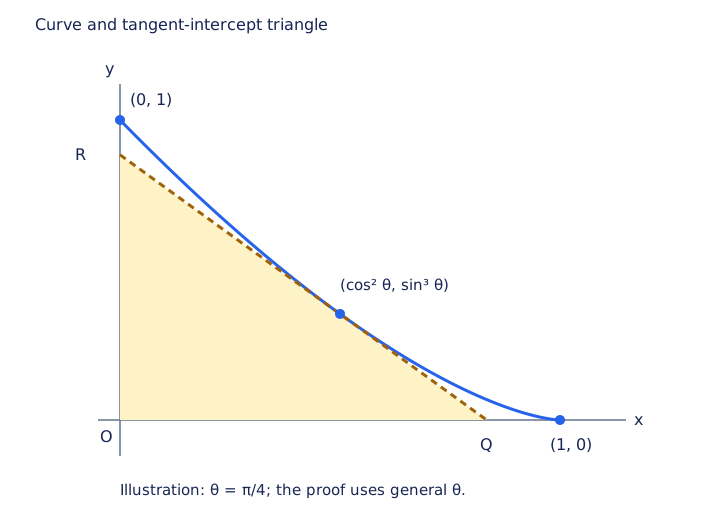
(i) Sketch the restricted first-quadrant curve
for . The curve joins the included endpoints and , decreasing and convex as a graph of . As increases, it runs from to .
(ii) Form the tangent, including the endpoint limits
and . In the interior, , so the tangent is . The one-sided Cartesian derivative gives the same expression at both endpoints, although both parameter derivatives vanish there.
(ii) Locate each intercept
For , putting gives . Putting gives . Write ; the positive intercept lengths are and .
(ii) Multiply the intercept lengths and state the degenerate case
The area is , as required. At , the tangent is the x-axis itself, so its x-axis intersection is not unique and a nondegenerate triangle is not defined. The printed formula has limit zero there; it is interpreted as the degenerate limiting area, not as a unique pair of tangent intercepts.
Compare your sketch
Expand diagramFit diagram to page
Use the scrollbars or arrow keys to inspect details.
Common mistakes
At theta zero the tangent coincides with the x-axis, so its x-intercept is not uniquely defined.