Worked solution
Keep the two dice ordered when checking event independence
Two fair dice, one white and one red, are thrown. Event A is that the white score is prime; event B is that the sum of the scores is 9.
(i) Find and hence determine whether A and B are independent. marks
(ii) Event C is that the red score is a perfect square. Find . marks
[2014/RVHS/II/6]
CJC · Review problems · Question 6
Answer
(i) , and A,B are independent; (ii) .
(i) Identify the favourable ordered pairs
Write each pair as(white, red). The white primes are 2,3,5, so . Sum 9 occurs for (3,6),(4,5),(5,4),(6,3), hence . The intersection A∩B consists of (3,6),(5,4), so .
(i) Conditional-probability test
, so A and B are independent.
(i) Source alternative: product test
, establishing the same independence.
(ii) Complement the union
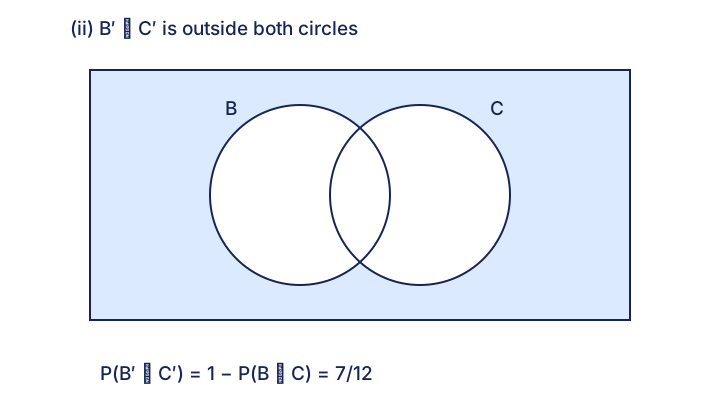
The red-die squares are 1 and 4, so . Among the sum 9 pairs, only (5,4) also has a square red score, giving . Therefore , and . The source diagram shades the outside of both circles.
Compare your sketch
Expand diagramFit diagram to page
Use the scrollbars or arrow keys to inspect details.
Common mistakes
1 is a perfect square but not a prime. Do not interchange the white-prime and red-square conditions.
Solution notes
Every printed case, both independence methods, union calculation, outside-both source diagram and marks retained.