Worked solution
Separate dependent sets from independent repeated matches
A and B play a racquet match of at most 3 sets. The first to win two sets wins. A wins the first set with probability 0.6. After the first set, A wins the next set with probability p given A won the preceding set; B wins the next set with probability 0.7 given B won the preceding set.
Find, in terms of p, the probability that A wins the match.
(i) The probability B won the first set given B lost the match is 0.15. Find p. marks
(ii) Given instead p=0.65 and that A’s third win occurs in the nth match with probability 0.10866 correct to 5 significant figures, write an equation for n and solve it numerically. marks
[2014/NYJC/II/6]
CJC · Review problems · Question 12
Answer
. (i) ; (ii) .
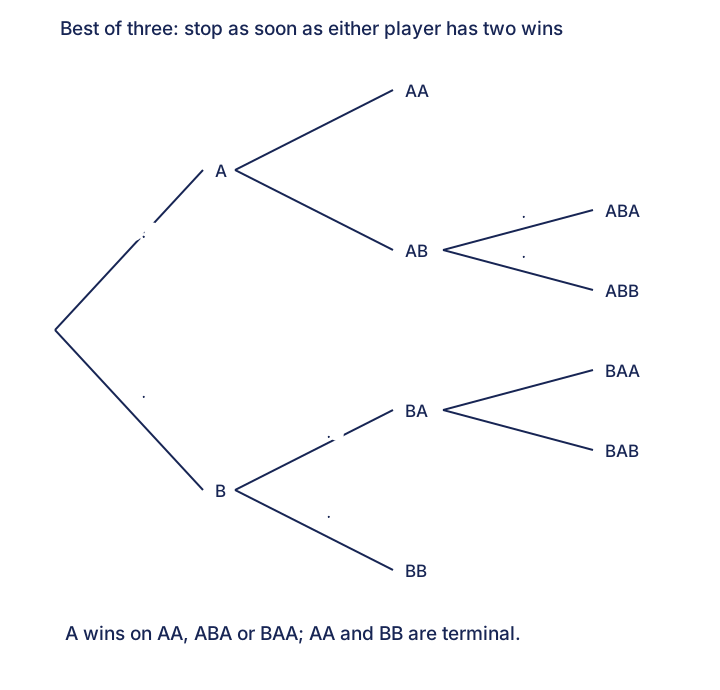
Retain the source’s stopping tree and winning paths
The source uses the previous-set transition model, so after B the next-A probability is 0.3. A wins on AA, ABA, BAA, with probabilities , and . Their sum is . No third set is played after AA or BB.
(i) B-first but A wins means BAA
B losing the match is A winning. Hence
Thus , so , retaining the source exact/decimal forms.
(ii) Use the source independent-match model
With p=0.65, A’s match-win probability is . The repeated-match calculation assumes matches are independent with unchanged win probability q. This does not make sets within a match independent; their transitions remain as given.
(ii) Third match win on trial n
The first n−1 matches must contain exactly two A wins, followed by an A win on match n. The source equation is
equivalently
Numerically, the integer solution is n=7. The supplied probability is rounded: for n=7 the left side is approximately 0.1086591224, which rounds to 0.10866 at 5 s.f. The rounded equality is interpreted accordingly.
Compare your sketch
Expand diagramFit diagram to page
Use the scrollbars or arrow keys to inspect details.
Common mistakes
Match-level independence in(ii) does not justify treating the sets as independent. Respect both the stopping rule and the rounded target probability.
Solution notes
Initial unnumbered ask, both marked asks, full stopping tree, all source path products, conditional equation, both negative-binomial equation forms and numerical answer retained. Source repeated-match independence is explicit; target 0.10866 is recognised as 5 s.f., not an exact rational constraint.