Worked solution
Treat fixed points as candidate limits before proving decrease
The sequence satisfies for positive integers .
(i) Find the exact value(s) of , the limit of . marks
(ii) Show that if , then . marks
[2008/TJC/JC1/MYE/6]
CJC · Review problems · Question 13
Answer
Possible finite limits ; in , . An initial term in that interval leads to limit .
(i) Find the possible finite limits
If the sequence converges to a finite limit , the recurrence gives , hence and or . A limit is impossible because the next term would become unbounded. Without an initial value or a convergence argument, these are candidate limits, not a proof that every iteration converges.
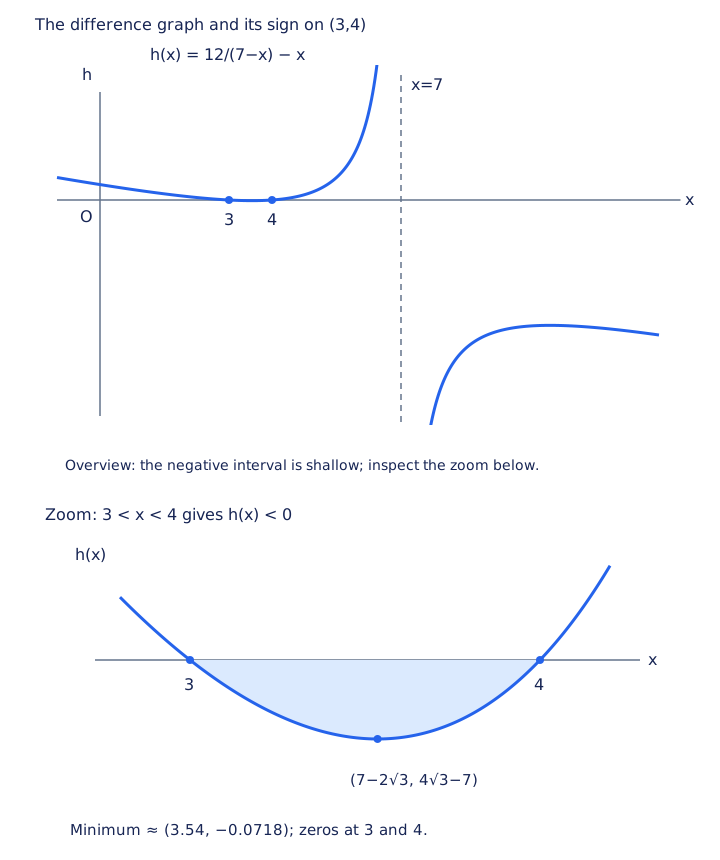
(ii) Retain the source difference-graph argument
Let . The source sketch has zeros at , a vertical asymptote , and a shallow negative minimum near . The exact minimum on the left branch is . The graph is below zero for , so .
(ii) Verify the sign algebraically and clarify the interval case
. In the numerator is negative and denominator positive, proving strict decrease. Also there. Thus if , the terms remain in that interval, decrease and are bounded below by ; their actual limit is . The constant sequence provides the other fixed-point limit.
Compare your sketch
Expand diagramFit diagram to page
Use the scrollbars or arrow keys to inspect details.
Common mistakes
A fixed-point equation identifies possible limits but does not establish convergence for unspecified starting values.