Sequences and series
Practice section 15 of 17
Questions 85–90 in this collection
Practice questions
Review practice · 1 of 6
Compare positive denominators to prove a strict lower bound
Given , deduce . [2]
[2013/JJC/I/3(modified)]
CJC · Review problems · Question 9
Solution
Review practice · 2 of 6
Sum the rows of a triangular labelled board
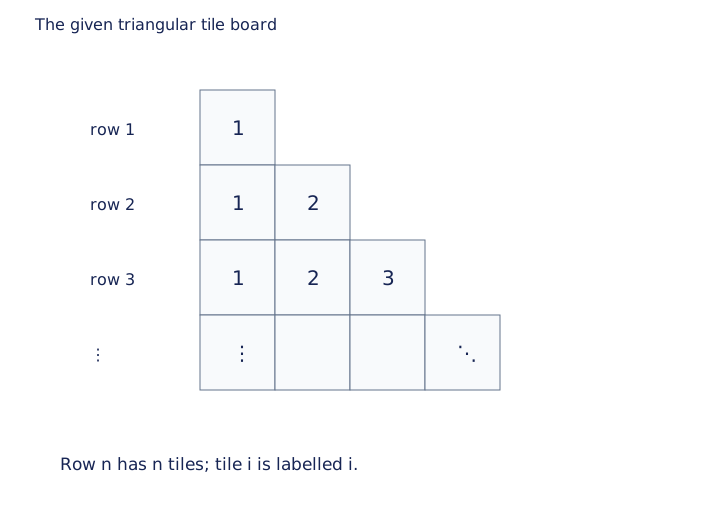
The n-th row from the top of a board has n tiles, labelled from left to right, as in the diagram. Given , find the sum in the k-th row and hence show the sum of all numbers in n rows is . [4]
Expand diagramFit diagram to page
Use the scrollbars or arrow keys to inspect details.
[2017/NYJC/I/1]
CJC · Review problems · Question 10
Solution
Review practice · 3 of 6
Distinguish a sequence of geometric sums from its own sum
The sequence begins , , , , … .
(i) Show its n-th term is . [2]
(ii) Find the sum of its first n terms. [3]
[2013/VJC/Promo/1]
CJC · Review problems · Question 11
Solution
Review practice · 4 of 6
Recognise factorial growth from the recurrence
Find the first seven terms of , , and a formula for .
CJC · Review problems · Question 12
Solution
Review practice · 5 of 6
Treat fixed points as candidate limits before proving decrease
The sequence satisfies for positive integers .
(i) Find the exact value(s) of , the limit of . [3]
(ii) Show that if , then . [3]
[2008/TJC/JC1/MYE/6]
CJC · Review problems · Question 13
Solution
Review practice · 6 of 6
Count elapsed updates separately from the week label
An insect colony initially has insects. Each week its population doubles, then die through competition and limited resources. Let be the population at the beginning of week , , with all remaining insects alive.
(i) Form a recurrence relating week n and week n−1. [1]
(ii) Find the minimum number of weeks needed for the population to exceed . [2]
[2006/MJC/Promo/2(b)]
CJC · Review problems · Question 14