Worked solution
Use two distinct real roots to restrict a parameter
The numbers and satisfy the equation
.
If a real value of is substituted, the equation becomes a quadratic equation in . Given that two distinct real values of may be found from this equation, show that
,
and hence find the set of possible values of .
[2004/I/5]
CJC · Review Problems · Question 15
Answer
or .
Discriminant
Regard the equation as . Two distinct real roots require . Dividing by 4 gives , or . Hence , as required. Equivalently the undivided discriminant is .
Possible inputs
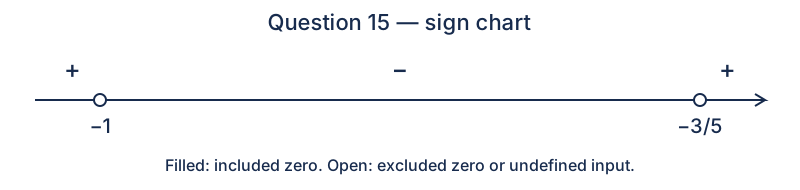
Factor: . The sign sequence across is . Therefore . Both boundary inputs give a repeated root in , so both are excluded.
Compare your sketch
Expand diagramFit diagram to page
Use the scrollbars or arrow keys to inspect details.
Common mistakes
Using D≥0 would admit repeated roots and incorrectly include both boundary values.
Solution notes
The diagrams are independently reconstructed mathematical equivalents. The plotted geometry is illustrative; use the labelled exact or approximate values and the stated domain.
No marks are printed for Q15.