Worked solution
Recover a signed graph from its two modulus graphs
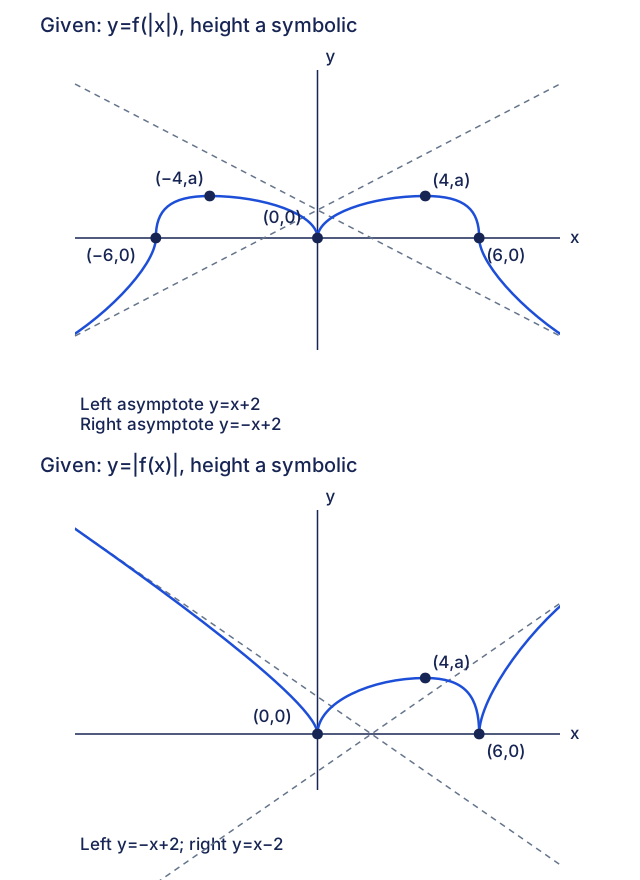
The supplied graphs are and . Both have maximum (4, a) and vertical tangents x=0, x=6. The first is even, with maxima (−4, a), (4, a), zeros (−6,0), (0,0), (6,0), and slant asymptotes y=x+2 on the left and y=−x+2 on the right. The second is nonnegative, with zeros (0,0), (6,0), and slant asymptotes y=−x+2 on the left and y=x−2 on the right.
Given f itself has only one oblique asymptote, sketch , stating asymptotes, turning points and axial intercepts wherever possible. marks
Expand diagramFit diagram to page
Use the scrollbars or arrow keys to inspect details.
[2020/RI/Promo/8(ii)]
CJC · Review problems · Question 9
Answer
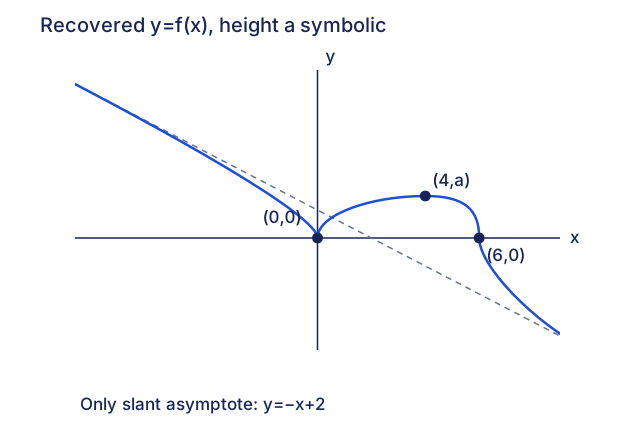
Asymptote y=−x+2; minimum (0,0), maximum (4, a); axial intercepts (0,0), (6,0). Positive for x<0, negative for x>6; a remains symbolic.
Recover the nonnegative-x portion first
For x≥0,, so use that supplied right-hand branch unchanged. It starts at (0,0), rises to maximum (4, a), crosses at (6,0), then becomes negative and approaches y=−x+2. The vertical tangents at x=0,6 are retained; they are not vertical asymptotes.
Choose the left-hand sign using the single oblique asymptote
The original has only one oblique asymptote, already identified as y=−x+2 from its right tail. Hence its left tail also approaches y=−x+2, which is positive as x→−∞. The supplied |f(x)| left branch has no further zeros, so the continuous branch stays positive for x<0. Use that branch without reflecting it downward.
State the labelled features without inventing a
The recovered graph has minimum (0,0), maximum (4, a), x-intercepts (0,0), (6,0), and y-intercept (0,0). Its only oblique asymptote is y=−x+2. The height a is not numerically determined; the schematic leaves it symbolic. The reflected zero at (−6,0) belongs to f(|x|), not to the recovered original f.
Compare your sketch
Expand diagramFit diagram to page
Use the scrollbars or arrow keys to inspect details.
Common mistakes
A vertical tangent is not an asymptote. The maximum height a cannot be read as a numerical value from a schematic.
Solution notes
Both original modulus figures and the printed recovered curve reconstructed. All source labels, tangent conditions, one-asymptote reasoning and positivity conclusion retained. The rendered vertical scale is schematic with a symbolic, not a claimed fixed number.