Graph transformations
Practice section 9 of 9
Questions 49–53 in this collection
Practice questions
Review practice · 1 of 5
Compare modulus, negative scaling and reciprocal graphs
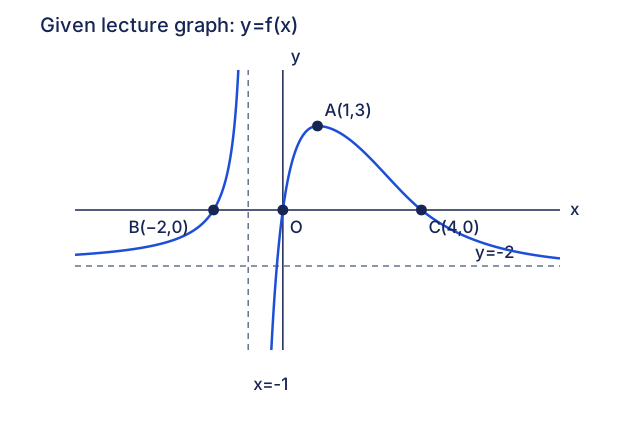
The given graph has asymptotes , , turning point , and zeros , , .
(a) State the turning point of . [1]
(b) Sketch , labelling asymptotes and the points corresponding to A,B,C. [2]
(c) Sketch with those labels. [3]
(d) Sketch , labelling asymptotes, turning points and axis crossings. [3]
Expand diagramFit diagram to page
Use the scrollbars or arrow keys to inspect details.
[2022/YIJC/Promo/6]
CJC · Review problems · Question 5
Solution
Review practice · 2 of 5
Undo a three-step transformation of an implicit curve
A reflects in the y-axis; B translates 4 units in the positive x-direction; C scales parallel to y by 2. A curve undergoes A,B,C in that order, giving . Determine its equation before the transformations. [3]
[2010/DHS/Promo/6(a)]
CJC · Review problems · Question 6
Solution
Review practice · 3 of 5
Reverse a translation, reflection and vertical scale
A translates 2 units in the negative x-direction; B reflects in the x-axis; C scales parallel to y by 2 with the x-axis invariant. Applied in order A,B,C, the resulting equation is . Find the equation before the transformations. [3]
[2012/RI/Promo/2]
CJC · Review problems · Question 7
Solution
Review practice · 4 of 5
Distinguish an absolute input from the order of affine transformations
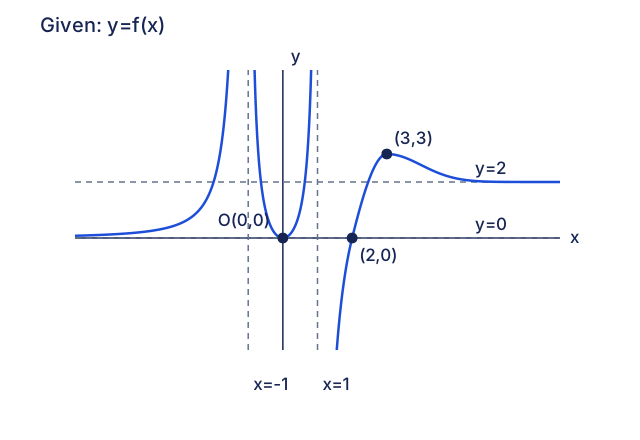
(a) The supplied graph has asymptotes y=0, y=2, x=−1, x=1, maximum (3,3), minimum at O and the right zero (2,0) shown. Sketch:
(i) ; [3]
(ii) . [3]
(b) Alfred and Betty are to transform to , with original and target .
Alfred’s steps, in order: 1.Scale parallel to y by 5; 2.Translate down 3; 3. Scale parallel to x by 1/2; 4. Translate along x by −1.
Betty’s steps, in order: 1.Translate along x by −1; 2. Scale parallel to x by 1/2; 3. Scale parallel to y by 5; 4. Translate down 3.
One person made an error in one step.
(i) Identify the person and incorrect step. [2]
(ii) Give the final equation resulting from that incorrect sequence. [1]
Expand diagramFit diagram to page
Use the scrollbars or arrow keys to inspect details.
[2012/SAJC/Promo/10]
CJC · Review problems · Question 8
Solution
Review practice · 5 of 5
Recover a signed graph from its two modulus graphs
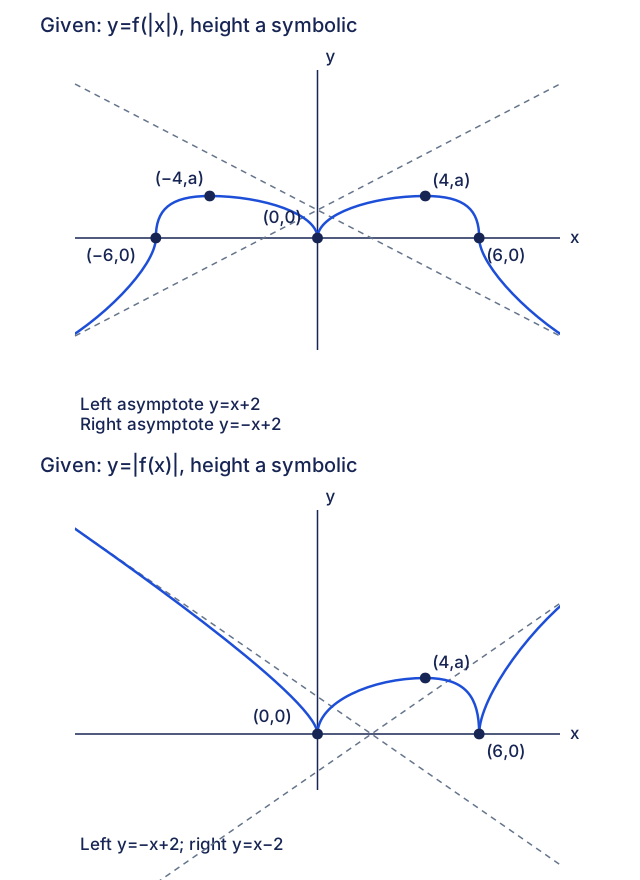
The supplied graphs are and . Both have maximum (4, a) and vertical tangents x=0, x=6. The first is even, with maxima (−4, a), (4, a), zeros (−6,0), (0,0), (6,0), and slant asymptotes y=x+2 on the left and y=−x+2 on the right. The second is nonnegative, with zeros (0,0), (6,0), and slant asymptotes y=−x+2 on the left and y=x−2 on the right.
Given f itself has only one oblique asymptote, sketch , stating asymptotes, turning points and axial intercepts wherever possible. [2]
Expand diagramFit diagram to page
Use the scrollbars or arrow keys to inspect details.
[2020/RI/Promo/8(ii)]
CJC · Review problems · Question 9