Porisma

Worked solution

Recover plane constants from an intersection line

Planes p1,p2 are 2x−5y+3z=32x-5y+3z=3 and 3x+λy+6z=μ3x+\lambda y+6z=\mu.

(i) They intersect in l:r=(4,−2,−5)+s(−2,1,3)\mathbf r=(4,-2,-5)+s(-2,1,3), s real. Show λ=−12 and find μ. marks

Plane p3 is 5x+8y+tz=125x+8y+tz=12.

(ii) Using(i), find the exact t if p3 does not intersect l. marks

(iii) Plane p4 contains l and (1,−1,2). Find its Cartesian equation. marks

[2010/RI(JC)/I/11(modified)]

CJC · Review problems · Question 7

Answer

λ=−12,μ=6; t=2/3; p4:4x+5y+z=14x+5y+z=1.

(i) Use a parallel direction and a contained point

Since l lies in p2,(−2,1,3)⋅(3,λ,6)=−6+λ+18=0(-2,1,3)\cdot(3,\lambda,6)=-6+\lambda+18=0, so λ=−12. The contained point gives μ=(4,−2,−5)⋅(3,−12,6)=12+24−30=6\mu=(4,-2,-5)\cdot(3,-12,6)=12+24-30=6.

How did this part go?

(ii) Enforce parallelism and exclude containment

(−2,1,3)⋅(5,8,t)=−10+8+3t=0(-2,1,3)\cdot(5,8,t)=-10+8+3t=0, hence t=2/3t=2/3. The point (4,−2,−5) gives 20−16−10/3=2/3≠1220-16-10/3=2/3\ne12, so l is not in p3; it is genuinely nonintersecting.

How did this part go?

(iii) Use two directions in p4

From the off-line point to the line point, a direction is (4,−2,−5)−(1,−1,2)=(3,−1,−7)(4,-2,-5)-(1,-1,2)=(3,-1,-7). Thus a parametric plane is r=(4,−2,−5)+α(−2,1,3)+β(3,−1,−7)\mathbf r=(4,-2,-5)+\alpha(-2,1,3)+\beta(3,-1,-7), α,β real. A normal is (−2,1,3)×(3,−1,−7)=(−4,−5,−1)(-2,1,3)\times(3,-1,-7)=(-4,-5,-1), so choose (4,5,1)(4,5,1). Through the line point,r⋅(4,5,1)=16−10−5=1\mathbf r\cdot(4,5,1)=16-10-5=1. Hence p4:4x+5y+z=14x+5y+z=1.

How did this part go?

Compare your sketch

Expand diagram

Use the scrollbars or arrow keys to inspect details.
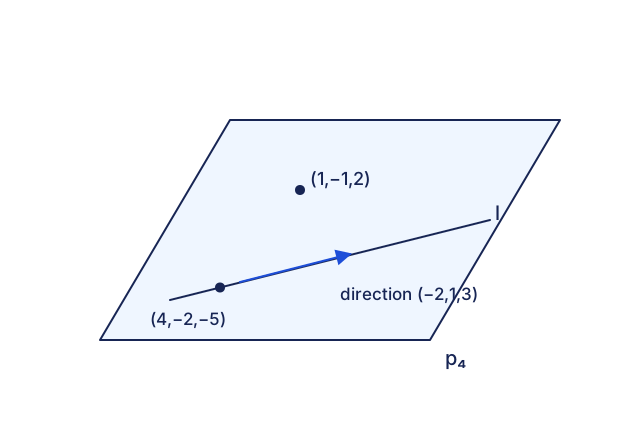
Plane p4 contains the line l through (4,−2,−5) with direction(−2,1,3) and the additional point (1,−1,2). The independent perspective schematic retains both point roles and the line arrow without treating screen locations as coordinate projections.

Common mistakes

Parallelism alone does not prove a line misses a plane; also check it is not contained.

Solution notes

All 3 asks, source parametric and scalar-product intermediate plane forms, cross product and source schematic retained. Noncontainment in(ii), implicit in the source, explicitly checked.

Read the hint