Porisma

Worked solution

Reflect a plane by retaining its intersection and reflecting one point

A,B have position vectors i−2j−k\mathbf i-2\mathbf j-\mathbf k and −i−2k-\mathbf i-2\mathbf k. Line l1 goes through A parallel to 5i+2j−k5\mathbf i+2\mathbf j-\mathbf k. Plane Π1 is r⋅(−1,1,2)=3\mathbf r\cdot(-1,1,2)=3.

(i) Find the acute angle between l1 and Π1. marks

(ii) Find the position vector of the perpendicular foot N from B to Π1. Hence find the reflected point B′. marks

Plane Π2 contains B and l1.

(iii) Find Π2 in scalar-product form. marks

(iv) Find the Cartesian equation of intersection l2 of Π1,Π2. marks

(v) Π3 is the reflection of Π2 in Π1. Find an equation r=u+sp+tq\mathbf r=\mathbf u+s\mathbf p+t\mathbf q, with s,t real. marks

[2016/HCI/Promo/10]

CJC · Review problems · Question 9

Answer

Angle 21.9°; ON=(−2,1,0)ON=(-2,1,0); B′=(−3,2,2); Π2:r⋅(0,1,2)=−4r\cdot(0,1,2)=-4; l2:x=−7,(y+4)/(−2)=zx=-7,(y+4)/(-2)=z; Π3:r=(−3,2,2)+s(2,3,1)+t(0,−2,1)r=(-3,2,2)+s(2,3,1)+t(0,-2,1).

(i) Method 1: complement the normal angle

With normal (−1,1,2)(-1,1,2) and line direction (5,2,−1)(5,2,-1), the absolute dot product is 5. Their acute angle is α=cos⁡−1[5/(306)]=68.1∘\alpha=\cos^{-1}[5/(\sqrt{30}\sqrt6)]=68.1^\circ(1d.p.). The line-plane angle is 90∘−α=21.9∘90^\circ-\alpha=21.9^\circ(1d.p.).

How did this part go?

(i) Method 2: use the sine directly

θ=sin⁡−1[5/(306)]=21.9∘\theta=\sin^{-1}[5/(\sqrt{30}\sqrt6)]=21.9^\circ(1d.p.).

How did this part go?

(ii) Method 1: intersect a normal line with Π1

BN:r=(−1,0,−2)+λ(−1,1,2)BN:\mathbf r=(-1,0,-2)+\lambda(-1,1,2). At N,(−1−λ,λ,−2+2λ)⋅(−1,1,2)=3(-1-\lambda,\lambda,-2+2\lambda)\cdot(-1,1,2)=3. Thus 1+λ+λ−4+4λ=31+\lambda+\lambda-4+4\lambda=3, λ=1, and ON=(−2,1,0)ON=(-2,1,0).

How did this part go?

(ii) Method 2: resolve a vector from a known plane point

D=(0,1,1) lies on Π1 and DB=(−1,−1,−3)DB=(-1,-1,-3). Its normal component is NB=DB⋅(−1,1,2)6(−1,1,2)=−(−1,1,2)NB=\frac{DB\cdot(-1,1,2)}6(-1,1,2)=-(-1,1,2). Consequently ON=OB−NB=(−1,0,−2)+(−1,1,2)=(−2,1,0)ON=OB-NB=(-1,0,-2)+(-1,1,2)=(-2,1,0) again.

How did this part go?

(ii) Reflect B through N

OB′=2ON−OB=2(−2,1,0)−(−1,0,−2)=(−3,2,2)OB′=2ON-OB=2(-2,1,0)-(-1,0,-2)=(-3,2,2), hence B′=(−3,2,2).

How did this part go?

(iii) Cross two directions in Π2

AB=(−2,2,−1)AB=(-2,2,-1) and (5,2,−1)(5,2,-1) are parallel to Π2. Their cross product is (0,−7,−14)=−7(0,1,2)(0,-7,-14)=-7(0,1,2). Through B, Π2:r⋅(0,1,2)=(−1,0,−2)⋅(0,1,2)=−4\mathbf r\cdot(0,1,2)=(-1,0,-2)\cdot(0,1,2)=-4.

How did this part go?

(iv) Solve for the intersection

Π1:−x+y+2z=3-x+y+2z=3 and Π2:y+2z=−4y+2z=-4 give x=−7. Thus l2:r=(−7,−4,0)+μ(0,−2,1)l_2:\mathbf r=(-7,-4,0)+\mu(0,-2,1) and its Cartesian form is x=−7x=-7, (y+4)/(−2)=z(y+4)/(-2)=z.

How did this part go?

(v) Keep the fixed line and add the reflected point

Π3 contains l2, a fixed line of the mirror plane, and B′. With E=(−7,−4,0) on l2,EB′=(−3,2,2)−(−7,−4,0)=(4,6,2)=2(2,3,1)EB′=(-3,2,2)-(-7,-4,0)=(4,6,2)=2(2,3,1). Thus Π3:r=(−3,2,2)+s(2,3,1)+t(0,−2,1)\Pi_3:\mathbf r=(-3,2,2)+s(2,3,1)+t(0,-2,1), s,t real.

How did this part go?

Compare your sketch

Expand diagram

Use the scrollbars or arrow keys to inspect details.
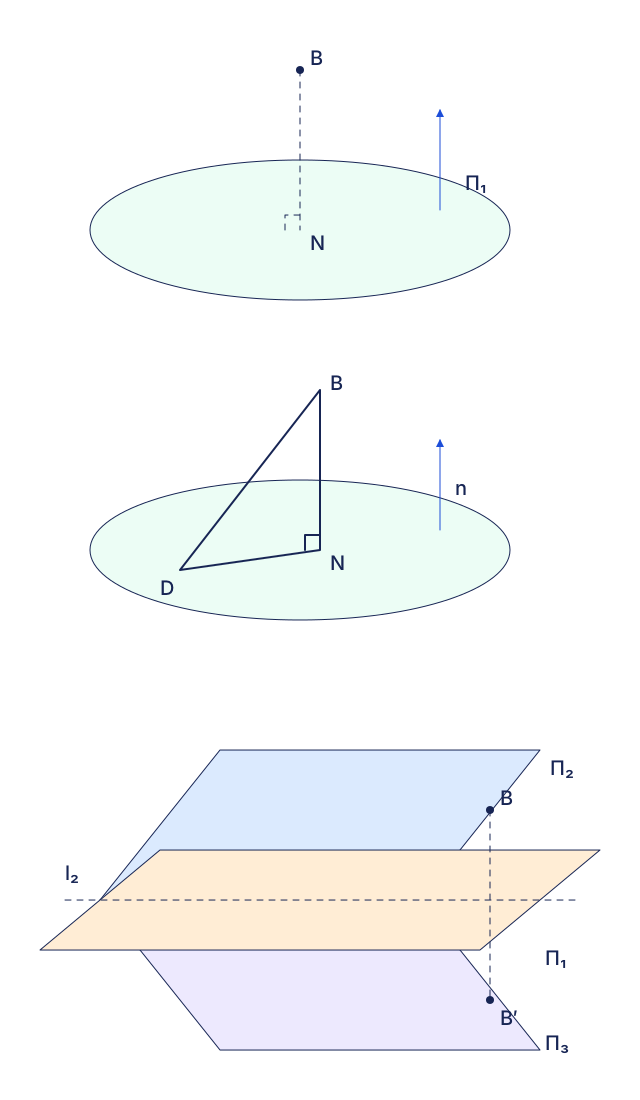
Upper: B lies off plane Π1, N is its perpendicular foot, and a normal arrow is shown. Middle: D=(0,1,1) is on Π1; DB is resolved into in-plane DN and normal NB. Lower: Π2 and its reflection Π3 meet the mirror Π1 along the same fixed line l2, with B and B′ reflected across Π1. All three source sketches are reconstructed as perspective schematics.

Common mistakes

Reflect one off-mirror point and retain the common line; do not reflect every coefficient independently.

Solution notes

All 5 asks, both angle methods, both foot methods, reflection/intersection steps and all 3 source sketches retained through a combined independent SVG.

Read the hint