Worked solution
Use line and plane distances to determine a parallel plane
P has position vector and lies on , x=2. Plane π1 is .
(i) Show the intersection Q of ℓ,π1 is (2,7,−10). marks
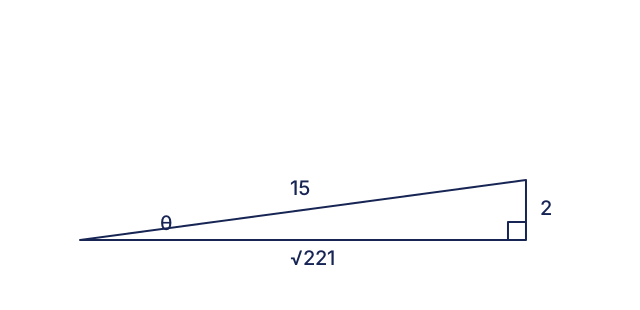
(ii) Find the exact sine of the acute angle between ℓ,π1. Hence find the exact length of projection of PQ onto π1. marks
Plane π2 is parallel to π1. M has position vector and is equidistant from ℓ and π2.
(iii) Find α if the distance from M to ℓ is 10. marks Hence deduce, when α>0, the Cartesian equation of π2. marks
[2016/NYJC/Promo/10]
CJC · Review problems · Question 11
Answer
Q=(2,7,−10); sinθ=2/15; projection ; α=±2; for α>0 and distinct π2:.
(i) Intersect the line with π1
. Substitution in π1 gives , or . Hence λ=−2 and Q=(2,7,−10).
(ii) Use the line-plane sine
The normal is of magnitude 3 and line direction has magnitude 5. Thus . Also , . With , the requested projection length is .
(iii) Distance method 1: vector product
. Crossing with the unit direction gives , so the distance is . Set this equal to 10, giving α=±2.
(iii) Distance method 2: a perpendicular foot
Put on ℓ, giving . Dot with : , hence λ=−1. Then , whose magnitude is , giving α=±2 again.
Hence, plane method 1: an auxiliary parallel plane through M
For α>0 choose α=2, so M=(2,12,0). The plane through M parallel to π1 has normal and constant . Write π2:. Its separation from the auxiliary plane must be 10, so , giving β=8 or −52. The intended distinct plane π2 excludes β=8, which is π1 itself, leaving .
Hence, plane method 2: point-to-plane distance directly
The distance from M=(2,12,0) to π2 is , again yielding β=8 or −52. Under the source’s distinct-parallel-plane interpretation, reject π1 and obtain . If coincident planes were allowed, the printed prompt would also permit π2=π1.
Compare your sketch
Expand diagramFit diagram to page
Use the scrollbars or arrow keys to inspect details.
Common mistakes
The source rejects π2=π1, so its intended parallel-plane condition includes distinctness.
Solution notes
All 3 printed parts and the separate 3 mark hence ask retained. Both distance methods, both plane methods, both constant branches and the sine-triangle figure retained. The distinctness assumption behind rejecting β=8 is explicit.